Thursday, September 16, 2010

St. Louis: A City of Neighborhoods

You hear it all the time:  "St. Louis is a city of neighborhoods".  It's true.  Many people love their neighborhoods, and associate with it very personally.  There are also many who don't know what neighborhood they live in and don't care.  Do we have too many neighborhoods?

Some neighborhoods tell a story.  Informing someone that you live in the Central West End immediately conjures up an image...whereas if you say you live in Fountain Park (right across the street from CWE) most will not know what the heck you are talking about. 

Some neighborhoods are branded well and recognized throughout the region.  The Hill, would be a perfect example.  Almost everyone in the city and the metropolitan region knows the Hill.  Soulard is another example of a clear regional identity that is well branded and defined.  Maybe we should sell this "city of neighborhoods" thing a little more.  Maybe this should be our city slogan.  Mound City, Gateway to the West....The City of Neighborhoods.  Who knows.

One thing I think would certainly help is to consolidate some of our neighborhoods.

79 neighborhoods is too much for a city of ~350,000 in my opinion.  Readers of this blog may be in the know about the city, but I would bet if you polled a thousand St. Louisians and 10,000 suburban/metro St. Louisians, they would have no idea what neighborhood they are in; or, could not provide you with the boundaries of College Hill or King's Oak.  Many St. Louis county people think they are in St. Louis and couldn't tell you how to get to Marlborough or Bel-Nor.  But the county's 91 cities are not my task to talk about...back to St. Louis.

Let's consolidate for Pete's sake.   Reducing the # of aldermen never seems to resonate with voters, so let's use them more wisely; we need to get lean and mean.  Give them more responsibility, raise the pay from $28,800, make it a full time, serious job.  Here are my suggestions to take St. Louis from 79 neighborhoods down to a more meaningful 29.
    • Consolidate Ellendale, Clayton/Tamm, Franz Park and Hi-Pointe into "Dogtown"
      • I add Ellendale because it has a very similar feel to the other official Dogtown neighborhoods...lots of frame home, very hilly, right on the western border of the city.
    • Cheltenham, Kings Oak and Forest Park Southeast become "the Highlands"
      • I've never identified with these neighborhoods as unique entities.  The Grove branding is one that never resonated with me.  I mean, it doesn't even border Tower Grove Park....what gives?
    • Mark Twain, Mark Twain/I-70 Industrial, Walnut Park East and West become "Walnut Park"
      • This whole area has a similar feel to me.
    • Hamilton Heights, Wells/Goodfellow, Kingsway East and West become "Kingsway"
    • Patch and Carondelet become "Carondelet"
      • This seems a natural fit.  When I was in the Patch, many described the area as Carondelet anyway.
    • Holly Hills and Boulevard Heights become "Holly Hills"
      • Boulevard Heights has never been well branded and the Holly Hills Neighborhood org. crosses into BH anyhow.
    • Tower Grove East, McKinley Heights and Fox Park become "Tower Grove East"
    • Baden and North Pointe become "Baden"
      • Two of the nicest north city neighborhoods...
    • Central West End, Academy, Fountain Park, Lewis Place and Vandeventer become "Central West End"
      • Talk amongst yourselves...
    • Botanical Heights, the Gate District, MidtownCovenant Blu/Grand Center and Tiffany become "Midtown"
      • I love this one
    • Jeff Vanderlou stays as is...no good reason other than its really big (in area)
    • Carr Square, Columbus Square, Hyde Park, St. Louis Place and Old North become "Old North St. Louis"
      • realize these are drastically different neighborhoods, but the momentum and positivity of the ONSL Restoration Group should/could bleed over into the neighboring areas.
    • St. Louis Hills and Lindenwood Park merge as "St. Louis Hills"
      • I think this would cause quite a stir with the STLHillers, you?
    • Princeton Heights, North Hampton and Southampton merge as "Southampton"
      • Seems like a natural fit
    • Mt. Pleasant, Gravois Park, Marine Villa, Dutchtown and Bevo become "Dutchtown"
      • you see Dutchtown signs all over these parts anyhow.
    • Wydown/Skinker, Skinker-DeBaliviere, West End, Visitation Park and Debaliviere Place become "The West End"
      • Spread the wealth, join hands, cross the divide and become one
    • Downtown and Downtown West are now simply "Downtown"
      • That's an easy one
    • The Greater Ville and the Ville merge as "The Ville"
      • Again, a very easy merge
    • Riverview, Near North Riverfront and North Riverfront merge as "Riverview"
      • Sell/brand the beauty that is the  Riverfront Trail and the Confluence and the Mighty Miss!
    • Shaw and Compton Heights become "Shaw"
    • The Hill and Southwest Garden merge as "the Hill"
      • Gulp...I hope I don't get relieved of my duties as a youth bocce ball coach
    • Hamilton Heights and Wells/Goodfellow merge
    • LaSalle merges with Soulard as "Soulard"
    • Tower Grove South stays as is
    • Kosciusko stays as is
    • Clifton Heights stays as is
      • for no other reason than I think this is one of the most unique areas of the city
    • Benton Park and Benton Park West merge to become "Benton Park"
    • Lafayette Square and Peabody/Darst/Webbe become "Lafayette"
      • The Georgian needs to be part of Lafayette, Truman boulevard needs to be crossable...maybe this would help...I don't think LS would go for this one (stoop so low)...but hey, I'm an idealist.
    • College Hill, O'Fallon, Fairgrounds Park and Penrose become "O'Fallon"
Whew...chop chop...I know your dander may be up; but, what's a blog post without a little personal provocation? 

Seriously though, I like this for several reasons.  As I already mentioned, it would build more of an identity within all areas of the city.  It would allow more branding.  It would infuse some diversity of economics, race, thoughts, etc.  Many neighborhoods need help from people who want to help, but have no ownership or collective way to join together.  It would be more manageable.  It would help lessen the whole north/south divide thing that plagues our city.  Damn it, it would just be easier to know where the hell you are.

Now I realize there are some historical and meaningful connotations with many of these neighborhood names and boundaries, but I'd be willing to overlook that.  And more than anything, I'm keenly aware of the fact that St. Louisans are ultra conservative and fear change like the plague.  But things change people.  The city is not the same today as it was when I moved here in 1994.  It's better and it's evolving and it's exciting. 

I really think this would be a meaningful step forward for the city.  Each new neighborhood would be comprised of a single non-political party affiliated alderman (with consecutive term limits), a neighborhood board and several NSO's.  The budgets would be based on density/population...not income levels or influence.  More people...more $$$$$.  It's that simple.  Maybe too simple, I'm just thinking out loud and having fun with the topic.

You know Internet statistics are very interesting.  It's enlightening to track what people are visiting this site for and what they are reading.  These neighborhood profiles are very popular and the most clicks are on the neighborhoods that people know and love, or are recognizable outside the region.  No body is clicking on Penrose or Walnut Park East or Boulevard Heights or Mount Pleasant....if we had ~30 maybe that would change and we could more easily advertise and promote the ENTIRE city.

What do you think?  What would you do?

Monday, September 6, 2010

The Hi-Pointe Neighborhood

Hi-Pointe is a southwest St. Louis neighborhood located south of Clayton Road and Oakland Avenue, east of the city limits, north of Dale Avenue and west of Louisville Avenue:
Hi-Pointe showed a decline in population from 1990 - 2000 of 7%, down to 2,454 residents.  86% white, 7% black, 3% Asian and 2% Hispanic/Latino.  There are 1,331 housing units of which 94% were occupied, 49% owner, 51% renter.  Another similar decline was noted in the 2000-2010 Census where 11% left the neighborhood leaving 2,196 people of whom 85% are white, 7% black, 5% Asian and 4% Hispanic/Latino.

Hi-Pointe is one of three neighborhoods collectively referred to as "Dogtown".  And like it's sister neighborhoods Franz Park and Clayton/Tamm, Hi-Pointe judiciously marks its territory with street light banners.
From the Hi-Pointe website
Recent past history (within the last 100 years) includes farming, a goat farm, clay mining for fire brick and tile manufacturing, and a small airport landing field. There are people now living in our neighborhood who have witnessed many of these changes. Being at the furthest edge of St. Louis, this neighborhood has not been densely settled for as long as many areas farther east. However, people of various persuasions have been here for many years, pursuing various occupations throughout the years.

This area was once considered part of Cheltenham, which now is bordering on the east side of the Clayton-Tamm neighborhood, which is on our east. Cheltenham built up during the 1800's around two main enterprises, several fire-brick and tile companies along Manchester Avenue, and a Tourist Hotel and Health spa near Sulfur and Manchester Avenues.

The 1904 World's Fair in the western portion of Forest Park and part of what is now University City did much to promote this area and to help settle it with more inhabitants. Some of the building materials available when the Fair was over have been used in the Hi-Pointe Area, it is said.

Many people refer to this area as a region of Dogtown. This name has seeming good recognition with neighboring regions, but the name Hi-Pointe is preferred by many residents. We are naturally proud of our neighborhood and seek to promote it as a decent and good place to live.
So there you have it.

Hi-Pointe's proximity to Forest Park, I-64, Metrolink, Washington University and the swanky suburb of Clayton makes this a highly desirable location.  And, it's an affordable option, unlike the higher priced homes of Wydown/Skinker, DeBaliviere Place and the Central West End that also border the park.

Hi-Pointe is also home to one of THE coolest movie theaters I've ever seen.  This place not only shows great films, but the experience is like no other in town.  It is legit and soulful in every way.  It is not pretentious and it's a true relic of its time.  Even the bathrooms (at least the men's room) is cool and unique.  And it's much more affordable than other city and county options.  If you haven't been to the Hi-Pointe Theater, you're missing out on a St. Louis landmark.  It was built in 1922 on the highest point in the city of St. Louis.
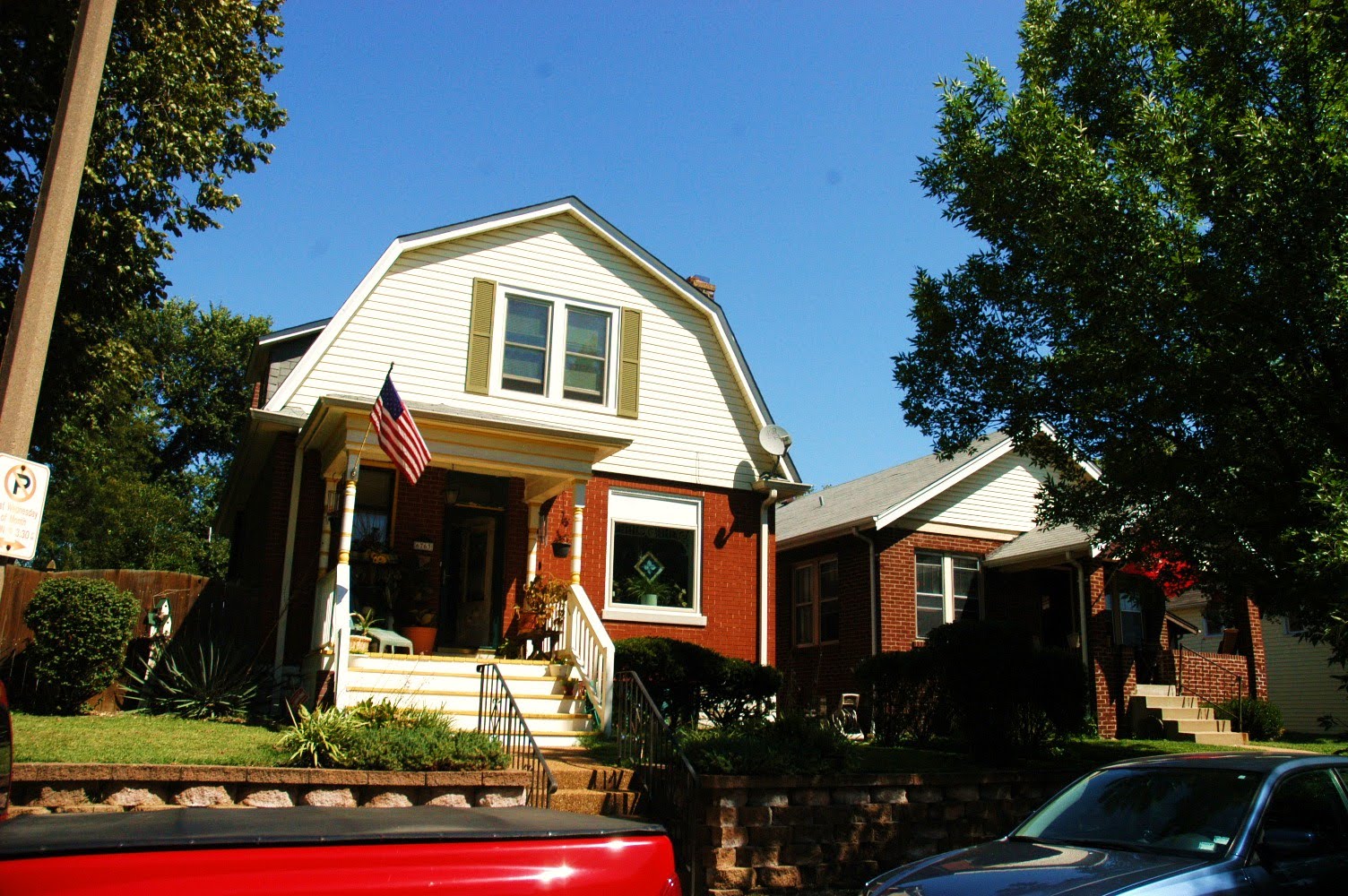
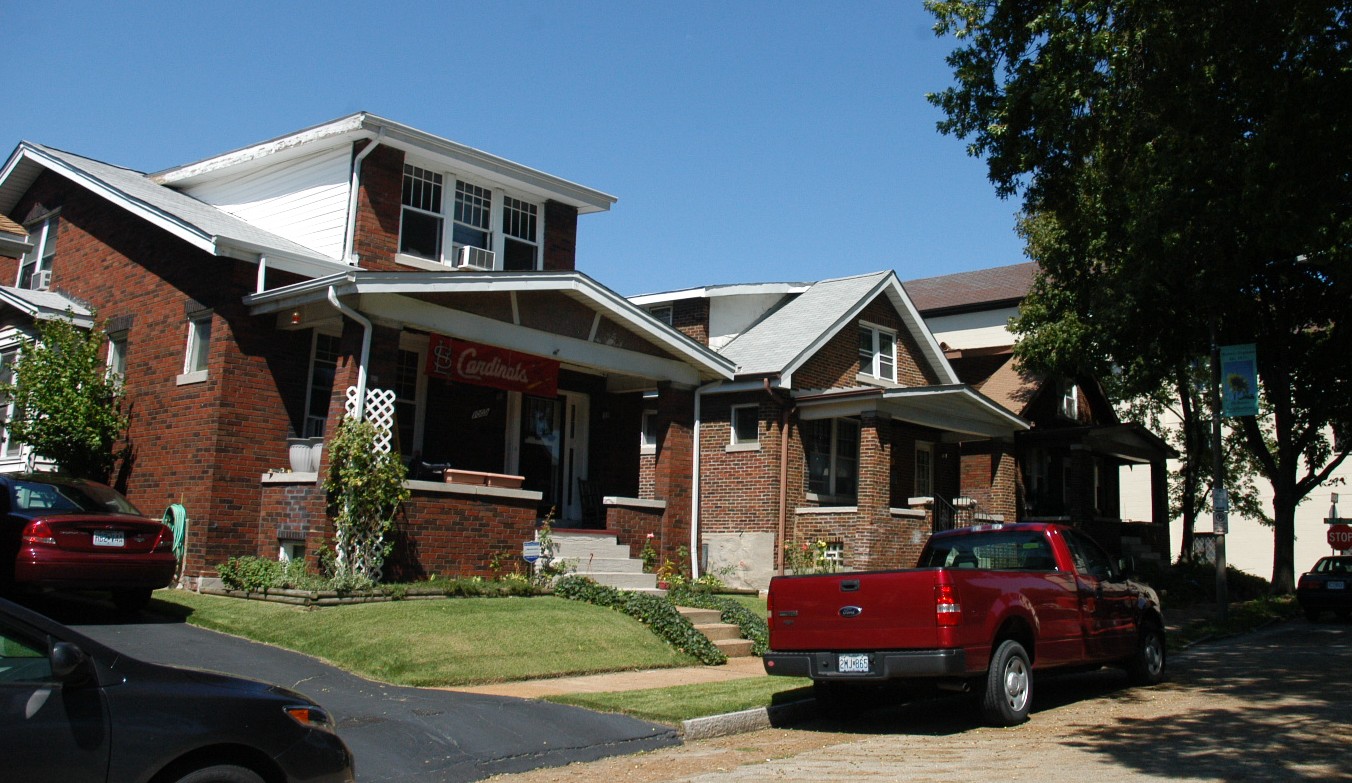
Hi-Pointe has a great mix of brick, stone and frame homes of all styles.  Like most of Dogtown, there is not a prevailing style or consistency of homes and streets giving it less of a clear identity as other St. Louis neighborhoods such as the Hill, Lafayette Square, Fox Park, St. Louis Hills or Holly Hills.

But, as seen below, the brick homes in Hi-Pointe are as beautiful as just about any St. Louis neighborhood:
Here are some the stone homes I found:
These two sit right next to each other:
And while brick and stone homes are the overwhelming majority in this fine city, there are great examples of frame homes in Hi-Pointe, not unlike Clifton Heights or Ellendale:
Hi-Pointe is similar to Franz Park in that there are several streets with rows and rows of modestly scaled homes, mixed between brick, frame and both side by side.  First the brick examples:
Then the frame/sided examples:
And then an example of a mixed brick and frame street:
There are some awesome apartment buildings within Hi-Pointe:
I was happy to find that Hi-Pointe has very few ramshackle properties and the rental property as well as the owned residential appears to be quite tidy, clean and well cared for.  Here are a couple beauties, the Lois and Kuhs apartments near the Cheshire Inn; the latter is undergoing a renovation:
There are also some examples of contemporary construction within Hi-Pointe, but these are the minority.

First you have some decent looking condos (aside from the Depot Doors):
But hey, density is density and we need all the residents we can get and the occupancy rate of Hi-Pointe is sky high, so obviously people want to live here.  The next apartments appeared to be near capacity as per the full parking lots.  I wonder if this would qualify as a bad mansard:
As per the map, I-64 runs through the north west part of the neighborhood, and many of the Hi-Pointe homes can be seen as you approach the Clayton Road overpass heading eastbound:
The uncalled for sound walls that block the views of our beautiful city have been incorporated into people's living spaces:
There are very few retail or other businesses within the Hi-Pointe neighborhood, but there are opportunities to add to the few open businesses that do exist today:
 ^You gotta love that mid-century building!

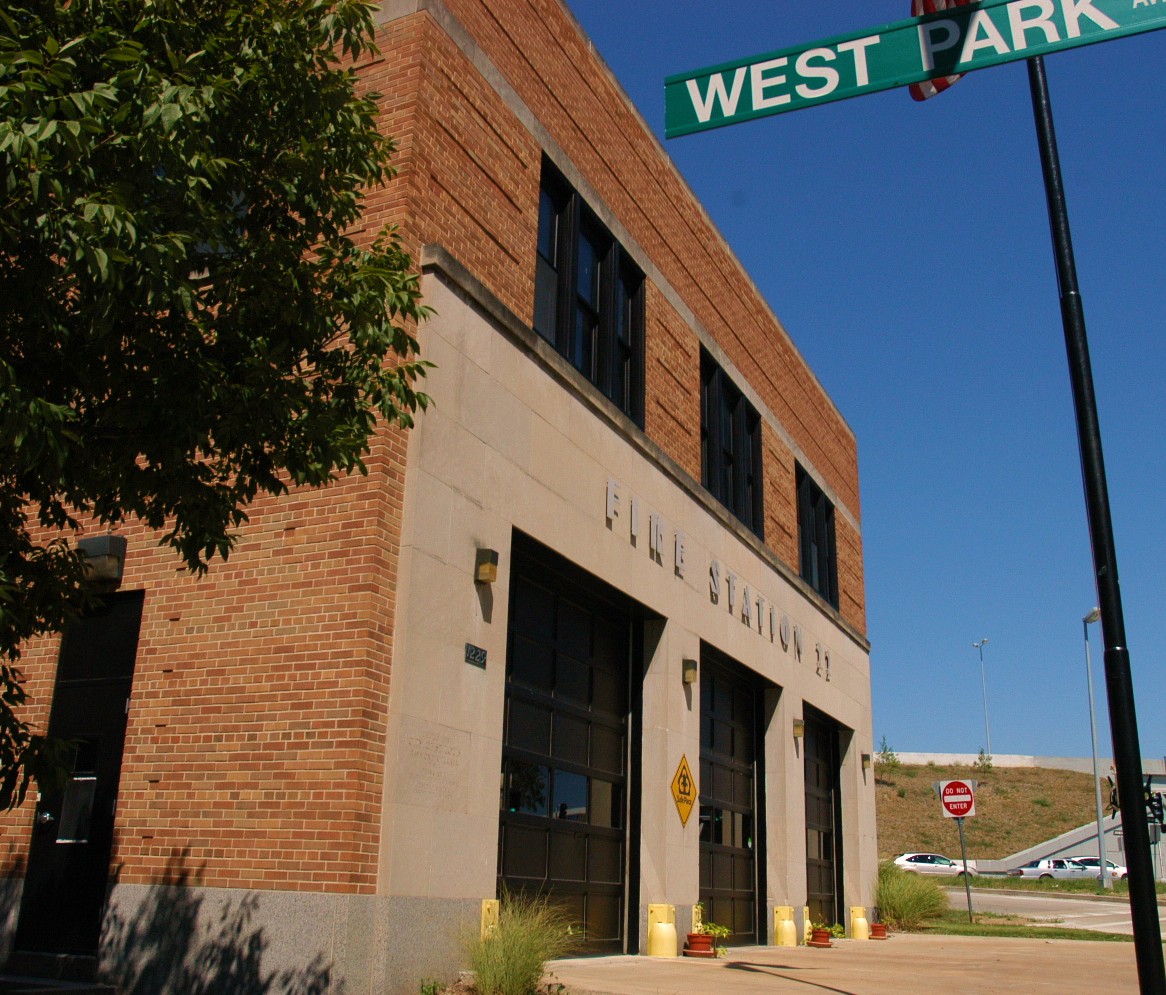
 Hi-Pointe institutions include the cool firehouse right at the McCausland exit of I-64 and Dewey School (International Studies):
There was a unique closed street that I believe is right on the city/county border.  I haven't seen one of these before in a working class neighborhood; as gated streets are usually reserved for the exclusive areas in Central West End, DeBaliviere Place, etc:
Overall, Hi-Pointe is a desirable place to live, with a nice mix of affordable to high end homes.  The location is superb and the neighborhood is clean and well cared for.  It's probably my favorite of the 3 Dogtown neighborhoods when it comes to housing stock, but Clayton/Tamm has many, many more businesses, restaurants and entertainment options.

I'll leave you with some of the nuance that I discovered along my way in Hi-Pointe:
This next sign is obviously a reproduction, but is undeniably cool and quite well done; this is something I'd like to see continued all over the city.
Usually Bob happy, but today Bob mad and he wanted to let everybody know:
I even viewed some livestock, both real and decorative (yes this is a guy riding a donkey down a city street):