Monday, September 10, 2012

The New Mississippi River Bridge and Tucker Boulevard

The new Mississippi River bridge, ramps and surface roads are taking shape just north of Downtown in the Near North Riverfront neighborhood.  With my curiosity piqued by a recent blog post on UrbanReviewSTL related to the insane amounts of surface parking lots lining Tucker Blvd. where traffic from the new bridge will be routed south into the city, I decided to take a quick ride over there to check on the progress myself.

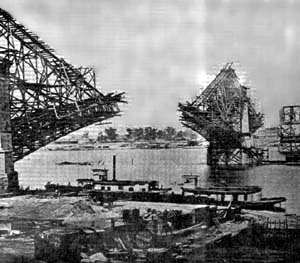
This is a historic project for our region and even our country.  You don't get many opportunities to witness construction of a bridge of this magnitude during a lifetime, so it seemed like more photos are in order to help document this work for future generations to look back on.  For more great info and photos of this project, click here for a NextSTL story by Herbie Markwort.  I am fascinated by photos of bridge construction, especially the elegant national treasure that is the Eads bridge:
A trip to the riverfront will provide you with excellent views of the massive, soon to be, cable-stayed bridge currently under construction.  This beauty will consist of two towers, with cables supporting the bridge deck.  The main span of the bridge will be 1,500 feet in length, with a total span of 2,803 feet.  Cables will stretch from the bridge deck to the tops of two A-shaped towers, which will reach 435 feet above I-70. According to the Illinois and Missouri Departments of Transportation, the new bridge’s main span will consist of 1,000 miles of 0.6-inch-diameter stay-cable strand, enough for nearly two round trips from St. Louis to Chicago. Nearly 15,000 tons of structural steel will be used, along with 8,600 tons of reinforcing steel. Some 90,600 cubic yards of concrete will be used in the foundation, deck slab, and towers. Upon completion, the bridge will be the third longest in the United States. (sources
This bridge is no joke and it should look fantastic, especially if lit up at night.  The towers are visible from many different vantage points within the city and the cables are being installed now.  I'm glad we'll have something special here as opposed to another Poplar Street Bridge clone which is as ho-hum and utilitarian as a bridge can be.
So what are we going to name this new modern marvel?  How about the Mound Cities Bridge?  I love the connection to the Cahokians who erected mounds on both sides of the river.  And, Mound Street runs parallel to the ramps that enter St. Louis.
It seems like it would be a missed opportunity if we didn't honor modern-day St. Louis' and Cahokia's connection to the remains of the most sophisticated prehistoric native civilization north of Mexico circa A.D. 700 - 1400.

Another great call would be something to do with Lewis and Clark or the Louisiana Purchase.  You can't really call it the Lewis & Clark Bridge though, because the other cable-stayed beauty to the north in Alton, Illinois is named the Clark Bridge.

I read of someone else who suggested the Mary Meachum Freedom Bridge which would be another great call for memorializing our rich local history.
In the early morning hours of May 21, 1855 a small group of runaway slaves and their guides crossed the Mississippi River at St. Louis, attempting to reach a route to freedom through Illinois. Accompanying them was Mary Meachum, a free woman of color and the widow of a prominent African American clergyman. Even today, the activities of the Underground Railroad remain largely shrouded in mystery. This event is remarkably different because the group was apprehended and, since the slaves belonged to the prominent St. Louisan Henry Shaw, a detailed story of the escape was covered in local newspapers. Thus was preserved for posterity a rare example, with exact location, of an Underground Railroad event in Missouri – in fact, the first documented site in the state. In December 2001, the Mary Meachum Freedom Crossing was dedicated as part of the National Park Service’s Underground Railroad Network to Freedom. (source
Anything unique to the area would please me.  However no such luck to date.  So far politician-supported names thrown out include "Veteran's Memorial Bridge" (which the MLK bridge used to be called), Ronald Reagan Bridge (he was from Dixon, Illinois...albeit > 250 miles from STL), "Jerry F. Costello-William Lacy 'Bill' Clay Sr. Veterans Memorial Bridge" (which just rolls off the tongue) was recently shot down or "Women Veterans Memorial Bridge".  Seems like we can do better, no?.  But at the end of the day, people will call it whatever they want.  You know the PSB is officially named the Bernard F. Dickmann bridge...but no one calls it that.

Anyhow, at an estimated cost of $667M, the new bridge was designed to reroute I-70 off of the Poplar Street Bridge which currently carries I-44, I-55, I-64, I-70 and U.S. 40.  The deck will carry 4 lanes of traffic and will be able to support another lane in each direction.  The bridge should be open to traffic as early as 2014 and full completion is slated for 2015.  The new bridge will forever change the skyline of our great city; and could be one of the most photographed/iconic structures in the region.

The bridge enters St. Louis near Cass Avenue and will take you northwest on the existing I-70 lanes or southeast through the city eventually spilling onto Tucker Boulevard.

Tucker Boulevard or Twelfth Street has been closed north of Washington Blvd. as long as I can remember.  The former Illinois Terminal rail tunnel that went under Tucker was filled in with huge styrofoam blocks and is still under construction.
This high profile stretch of road that divides Downtown from Downtown West has been an official city street since 1844. Its name was changed from Twelfth Street to Twelfth Boulevard in 1932. It became Tucker Boulevard in 1979 in honor of former mayor Raymond R. Tucker. (source)

I agree with Steve Patterson's conclusion that the glut of surface parking lots on both sides of Tucker is less than an inviting stretch of road and infill is greatly needed to make this look like a functioning urban street.  This used to be a vibrant section of the city and has been whittled away over the years to make way for get in/get out auto commuters, especially the Post Dispatch employees. 

Anyhow, projects this big don't come around very often, so the following is my attempt at capturing some photos of the work while still under construction and adding to the many others who are interested enough to photo document this historic project.

For many first time STL visitors, the trip down Tucker will be their first impression. The massive surface parking lots and dead zones are part of the true picture of Downtown St. Louis in its current state...until you get toward Washington Boulevard when things start to look like a real city.  However, if commuters and visitors choose to look up beyond the dead asphalt expanses, you are afforded some nice views of the city skyline. 


And if you are a pedestrian, there are plenty of careful details within the new infrastructure to catch your eye.

From granite curbs to island/median plantings:


To many new street trees and easement plantings, curb bump outs, drop off lanes for buses/taxis/cars and creative/non-standard paver stone patterns in the sidewalks:


To new pedestrian crossings, streetlights and signage:
The bridges are getting new fencing and the street lights are varied with a mix of modern and faux classic.  I like it, you?


Anyhow, take a walk or ride north of Washington Boulevard and witness for yourself this transformational project.  Hopefully investors too will note the opportunities of many, many more commuters and visitors entering the city on Tucker and will scoop up some vacant or under-utilized property to make this part of St. Louis part of St. Louis again!  Instead of some fast food row or other suburban ho-hum generica.

Yet, this project is by no means complete, so we can still hope for more sustainable investment in this part of St. Louis.  We have another example of the "clean slate" mentality that so many developers think is the ultimate necessity for new projects, only time will tell if it anything transformational really happens.
So far only McDonalds has ponied up with a typical suburban drive thru junk food restaurant.

Wednesday, August 29, 2012

Signs In The City

We need more metal and neon signs in this town.  They are vibrant and cool.  Prominent signs get people's attention and can even be landmarks
Big, artistic signs say BIG CITY; they let you know that the place/brand is important and noteworthy.  The Covenant Blu/Grand Center neighborhood has done a great job with exciting signs both old and new.  Look no further than the Big Brothers/Big Sisters sign that wraps around the recently renovated building at Grand and Lindell.  Then you've got the Fabulous Fox Theatre and many others in the area.  See what I mean: 
 
Hotel Ignacio before and after prominent signage:
photo source (Count On Downtown)
City Diner jumped in with a fantastic new addition to a prominent corner of the neighborhood:
Notice how the neon lettering says "City Diner At The Fox"?  That means permanency and investment to me.  It means the Fox is here to stay and is a landmark, and City Diner is putting their hard earned money up to be part of the city and its surroundings. 

With KDHX and KWMU moving to Grand Center, why not put up some awesome signage there as well?  Heck, KDHX's new building even has the framework already in place on the rooftop.  Check out this photo-shopped vision of what could be:
It's simple:  Big city = big signs. 

We have lost some really prominent signs over the years, the most recent being the Globe Democrat sign on North Tucker.
St. Louis was once home the Globe-Democrat Newspaper which was in existence from 1852-1986.  It began operations on July 1, 1852 as the Missouri Democrat, which later merged with the St. Louis Globe. It was St. Louis' conservative daily newspaper for much of its long run.  Political commentator, syndicated columnist, author, politician, speechwriter, and broadcaster Pat Buchanan launched his career at the Globe-Democrat in 1961 (at the age of 23) as an editor.
St. Louis was once a great, influential city and the Globe was part of the city for over 130 years.  It was built to last and the sign they put on their most recent building on North Tucker Boulevard was bold as well. 

I witnessed the sign being dismantled and hauled away recently. 


Another great sign gone, another great part of our history erased.

New signs are needed to make bold streetscapes that people recognize and identify with.  They bring vibrancy and train the eye upward to the amazing architectural details our forefathers graced their buildings with.

I would like to see our city's myriad of ghost signs get repainted to their original splendor too.  (I would like to start up a business and do this if anyone wants to partner and research if there's a market)  I'd also like to see more businesses with cool signage.  Now I realize these are not cheap, and with the huge amount of turnover of small businesses, I can see why a new business like Big Shark or Left Bank Books entering a new market Downtown would not want to invest in a sign before they get a good understanding of the business they will do in their new locations.  However, if they are making a profit and plan on being part of the city, let's see some eye-catching big signs to mark their territory and get people's attention.  Be part of the neighborhood and the street scene!

St. Louis needs more artists painting signs on buildings.  St. Louis needs to make it as easy as possible for business owners to erect huge, attention-getting, artistic signs.

We deserve it.

Friday, July 20, 2012

Some facts before I move on...

I wanted to get some facts on the table before I move on to some topics like regionalism and cross-county cooperation. 

Whenever I say 'St. Louis', I mean it literally.  I don't mean the combined statistical region, I don't mean our TV market, I don't mean Cardinal Nation, I don't mean unincorporated St. Louis County, I mean St. Louis...the city, you know?  The place with the Arch and the Big Muddy to the east, Forest Park and Skinker Boulevard to the west, The bluffs along the confluence of the Missouri and Mississippi Rivers & the old Chain of Rocks Bridge to the north and the St. Louis Skatium to the south (alright can you think of a better landmark between St. Louis and Bella Villa or Lemay, Missouri?)  Klebs Clothing or the River Des Peres would be righteous choices as well...

Anyhow, I don't point out these facts to further divide us or to be contentious in any way.  If I come across like that it's because I'm fed up with the fact that the majority of people I talk to DO NOT GET THIS.  I simply want the truth to be realized.  I am not drawing a line in the sand and saying St. Louis (my favorite city in the region) should separate itself from it's less exciting, but much more well-monied/well-educated influential neighbors.  It's actually quite the opposite.  I simply want to speak honestly and accurately about our region and my city.  In order to do that you have to face some facts:
  • St. Louis City is its own County as well. St. Louis is not part of St. Louis County. It is in St. Louis City County (I kid you not, I learned this the first time I used Turbo Tax to file...it's true).
  • There are 90 cities in St. Louis County (St. George just dis-incorporated) and huge swaths of unincorporated land, none of which can accurately be called St. Louis.
  • Each city in St.Louis County has its own political, tax and other city entities. They have nothing to do with St. Louis.
  • If you live in St. Louis County and work there, you don't pay any St. Louis income or property taxes.
  • If you live in St. Louis County or elsewhere in the region and work in St. Louis, you pay 1% earning tax to St. Louis.
  • If you work in St. Louis County or elsewhere but live in St. Louis, you pay an additional 1% income tax earnings tax to St. Louis.
  • If you live in St. Louis County you cannot vote on St. Louis issues (mayor, taxes, reducing the # of aldermen, etc); and vice versa.
  • As of July, 2011 official Census data, St. Louis had a population of 318,069.
  • St. Louis is the 58th largest city in the United States, wedged right between Santa Ana and Riverside, California. (source)
  • The Greater St. Louis combined statistical area's (CSA) population of 2,878,255 and is the 16th-largest CSA in the country, the fourth-largest in the Midwest. The Greater St. Louis area is the largest metropolitan area in Missouri. 
  • St. Louis has the 62nd greatest population density/square mile of land area, wedged right between Erie, Pennsylvania and Detroit, Michigan.
  • In the late 1960's the city and county voted for a special Metropolitan Zoological Park and Museum District to raise money based on property taxes in the county AND city to go toward funding essential cultural institutions in St. Louis.  The Art Museum, Zoo and Science Center were included; Botanical Gardens were added in 1983 and the History Museum was added in 1988 (source).   
  • On March 23, 2007, the Missouri State Board of Education ended its accreditation of the St. Louis Public Schools and simultaneously created a new management structure for the district. A three-person Special Administrative Board was created, with members selected by the Missouri governor, the mayor of St. Louis, and the president of the St. Louis Board of Aldermen. The current board has authority to operate the district through 2013. The local school board remains in place but has no administrative authority over the district.  Cities in St. Louis County have their own school districts, distinctly separate from St. Louis'.
  • St. Louis does not have local control of its police force.  St. Louis County and many municipalities have their own police and fire depts.
A brief break from the facts into opinion:  what are the 2 biggest issues facing St. Louis?  Many will tell you the schools and crime.  Hmmm, we don't have local control of either...

Similarly clustered up, St. Louis runs the suffering Lambert International Airport located in unincorporated St. Louis County between the cities of Bridgeton and Berkeley, Missouri.   The state voted down our ability to lure in international cargo business with the 2nd largest economy in the world:  China (source).  We are being held back as a region by competing interests and entities that should be feverishly working together to stem the bleeding and disinvestment.  We have external interests more powerful than our own controlling many of our key local interests.  I feel the county and state work against St. Louis more often than not.  That needs to change.

But when we do work together, the results can be astounding.  For example, the Zoo, Art Museum and Botanical Gardens are world-class institutions.  Every property owner in St. Louis and St. Louis County should be proud of there contribution to these amazing places.  This is the premier example of x-county monetary cooperation that I can think of.  Another prime example of x-county fruit is the Great Rivers Greenway District, funded by a 1/10th of 1 cent sales tax raised in St. Louis City, St. Louis County and St. Charles County, which generates $10 million annually. We can all be proud of that one too, and the bike trails seen throughout the city and county unite us as opposed to dividing us.
Maybe I'm in the minority in thinking that this region is drastically over engineered from a political standpoint...but the simple fact is, both St. Louis and St. Louis County are losing population.  People are voting with their feet and vacating this region at alarming rates.

Here are some other Midwestern cities and how we compare:

  • Indianapolis, IN #12 in population @ 827,609
  • Columbus, OH #15 in population @ 797,434
  • Nashville, TN #26 in population @ 609,644
  • Oklahoma City, OK #30 in population @ 591,967
  • Kansas City, MO #37 in population @ 463,202
  • St. Louis, MO #58 in population @ 318,069
We are a tiny city bleeding residents.  We are a large metropolitan region that is fractionalized more than maybe any region in our country.  The political systems are bloated and the people are stubborn.  We are an inbred (read: promotes from within entreched ranks) region that doesn't like change and is wary of new comers and progressive thought patterns.  We're now seeing where that is getting us.  2010 Census data indicate that the mighty County of St. Louis has posted its first population loss in its short history.  The city is bleeding, the formerly shiny all white suburbs are aging and showing signs of slipping infrastructure, unsafe streets, mounting debt, etc.  The County population is wicking out to St. Charles and other green fields to find cheaper new construction and less pesky poor people, with their social ills and minorities.  We have to fix this.  We need to be honest about where we live and how services get paid for and who foots the bill.  We need to embrace our problems and assets as a unified region, not a bunch of petty little suburban fiefdoms and one formerly grand city.  We need to become the biggest city in Missouri.

Understanding these facts are an important place to start.

I am not from St. Louis, so I had to learn these things myself.  And don't believe the Interstate signs sprinkled throughout St. Louis County, they too are misguided in false local lore, as the "Welcome to St. Louis" signs exist miles from St. Louis' actual borders:

I hope these facts are clear and provide readers with the proper context when thinking about and debating regional issues in an honest manor.