Sunday, January 12, 2014

Sister Marie Charles Park

Sister Marie Charles Park is 1 of 108 St. Louis parks .  The park is located in the Carondelet neighborhood.  The park makes up 3 of the total 2,956 acres of parkland in St. Louis.  Placed into ordinance in 1982, the park is right along the banks of the Mississippi River near Broadway and Elwood Avenue.


This is one of those parks that is a real bummer to visit, not because of the condition or anything like that, but because of the fact that this is a place where all male trysts occur in broad daylight.  I would be remiss in speaking about this park if I didn't mention this fact.  It is brazen and straight up creepy.  There is a predatory, disgusting feel to the whole scene that takes place in the parking lot of this park.  Upon your arrival, you will be met with stares from mainly old men, but some younger guys too.  Rainbow stickers on some cars, others not.  This is not a welcoming site.  When I got out of my car with camera fully visible and starting taking photos, only a few trucks/cars took off.  The others stayed just staring straight ahead in their vans, trucks and a couple cars.  The stream of traffic continued on my visit, with people doing kind of a drive-thru type thing, slowing down, making eye contact, some stopping some moving on.


This could be dealt with a simple camera and signage that says, "smile you are on film".  Seems simple, right?  This should be the work of the city government and park's dept to maintain civility on their property, no?  Public safety is at risk here.  This is not a happy place.

Anyhow, the park is located literally right along the river, affording great views of the Mighty Miss.


There is basically a burm of grass to the east of the railroad tracks that run along the bluffs.  Bellerive Park sits atop the bluffs, as do some senior living apartments.


The park has a few places to sit and watch the barges go by and there were lights installed, most destroyed.


Update 01/14/14:  I am trying to locate the correct info on how the park was named.

The park's dept and the city should take a stand and put an end to the negative behaviors on display here.

Marquette Park

Marquette Park is 1 of 108 St. Louis parks making up 16.96 of the total 2,956 acres of park space.  Placed into ordinance in 1915, the park was named after Pere Marquette:
Father Jacques Marquette S.J. (June 1, 1637 – May 18, 1675), sometimes known as Père Marquette or James Marquette, was a French Jesuit missionary who founded Michigan's first European settlement, Sault Ste. Marie, and later founded St. Ignace, Michigan. In 1673 Father Marquette and Louis Jolliet were the first Europeans to explore and map the northern portion of the Mississippi River. (source)


The park is located in the Dutchtown Neighborhood, bordered by Osage Street to the north, Gasconade Street to the south, Louisiana Avenue to the west and Minnesota Avenue to the east.  South Compton Avenue goes right through the park and kind of divides it into two:


The park has a beautiful setting in the shadow of the dual steeples of St. Anthony of Padua on Meramec Street.


The homes that line the park are diverse in style and are Dutchtown classics.

 brick streets, brick homes


This area has seen better days and I don't think has hit rock bottom yet.  But it is still hanging on.

The park is unique in that it has functioning swimming pools.


There are also multi purpose fields, tennis courts and playgrounds.


Another unique set up for a park is the Thomas Dunn Learning Center just south of the pool house.


Here's some information on the learning center:

The Thomas Dunn Memorials Adult Education Program is a not-for-profit organization committed to enhancing the lives of St. Louis adults through practical application of communication, critical thinking, career training and development, personal growth, family relations, and life skills. We have no tests, no grades - and no tension! Thomas Dunn Memorials Adult Education Program was launched in 1962 under the direction of a dedicated, volunteer Board of Directors. Since then, we have successfully sustained our founder’s vision for a learned and peaceful society by helping thousands of participants recognize, define and realize their physical, mental, moral and social goals for personal growth. (source)

Read the full history of Thomas Dunn and his memorials HERE.

"Papa" Dunn was laid to rest in Bellefontaine Cemetery:


There is a beautiful service building that is falling into severe disrepair and needs resources now if it is to remain.  The parks department does so little maintenance, even controlling vegetation in the parks.  The stairs leading up from the parking lot near this service building are completely blocked by weeds and vines.


Maybe is we ever merge the city and county parks departments some accountability will be required and our parks will get the maintenance and care they and we deserve.

Laclede Park

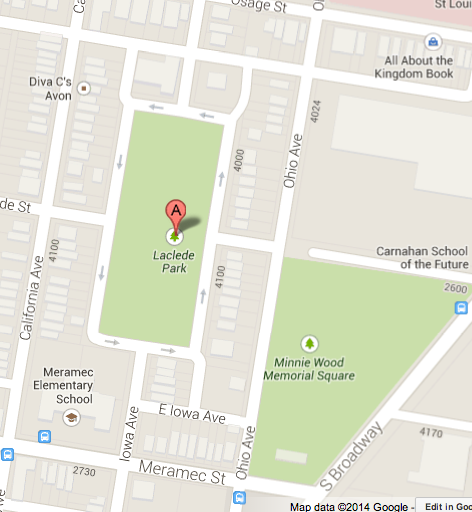
Laclede Park is 1 of 108 St. Louis parks.  It makes up 3.17 of the total 2,956 acres of park land in the city.


The park was placed into ordinance in 1812 and is part of the Dutchtown Neighborhood bordered by East and West Iowa Avenue in a rather strange setting that seems to buck the recti-linear street grid.


The oddest thing about this park is it predates the nearby Minnie Wood Memorial Square just a block to the east by 113 years.  It is almost like Minnie Wood got all the resources and Laclede Park was completely abandoned.  Nothing exists in Laclede Park.  Nothing.


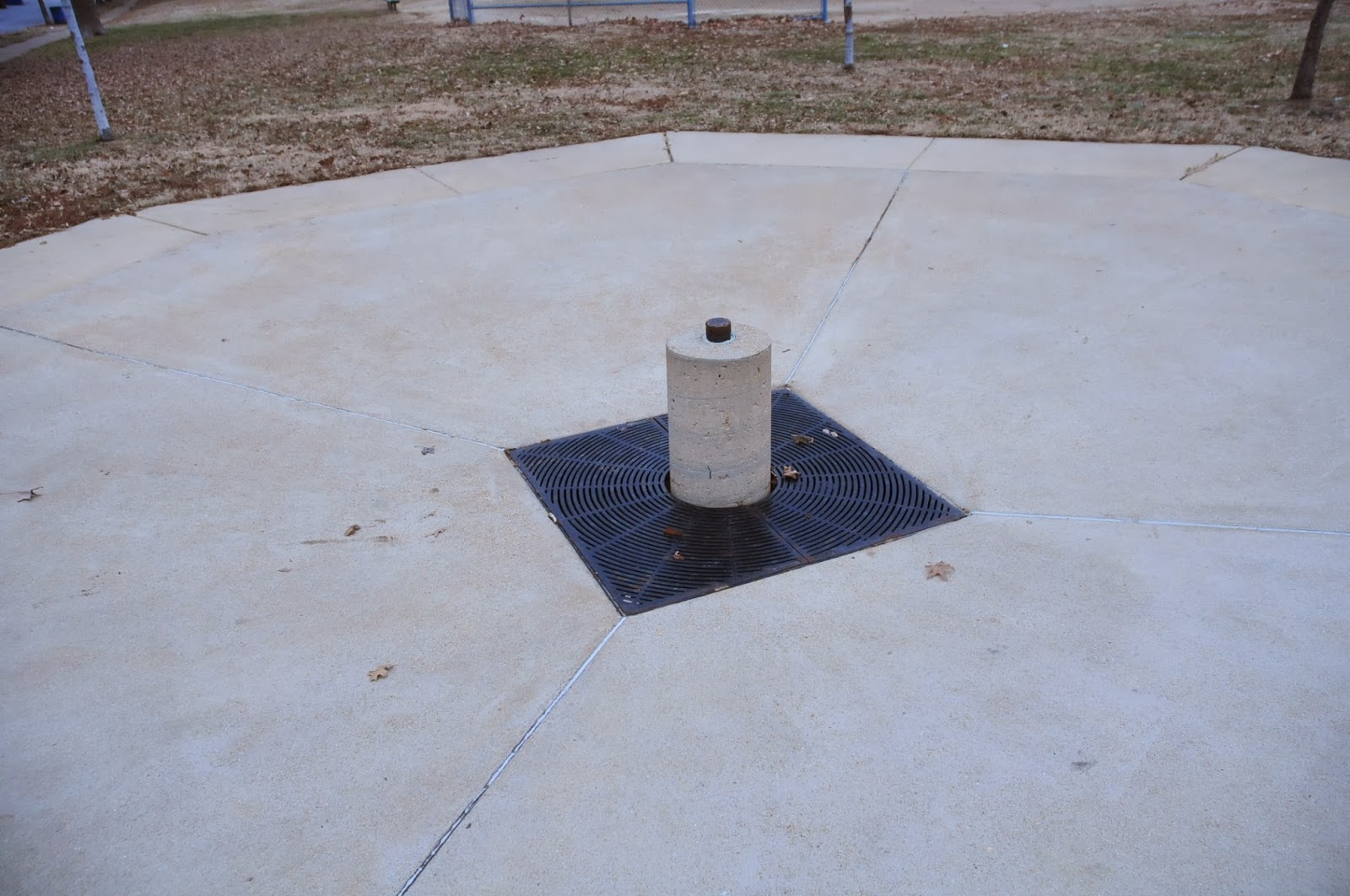
You can tell Laclede Park once had a centerpiece, maybe a gazebo or stage.  But as it stands today it is just an empty field of grass and weeds.


The homes that surround the park are beautiful, and in various states of repair.  The back sides of the properties are visible from the park and East and West Iowa really serve as the alley for these homes.  The double spires of St. Anthony are visible in the distance:


There are 2 school buildings, one active in the beautiful 1910 William B. Ittner Meramec Elementary School which is kind of the twin of Mullanphy School in the Shaw neighborhood.


It is great to see investment in our historic schools.  New windows were recently added and many other upgrades are planned from the recent Prop S approval.

The other school, St. Thomas of Aquin, was abandoned by the Catholics in their continued migration out of St. Louis to the suburbs.  The locals have taken to breaking into the school and breaking the windows.  Of course it won't be secured and the slow decline has started for this beautiful building built in 1932.


For a park that takes its name from the French fur trader who, with his young assistant and "stepson" Auguste Chouteau, founded St. Louis, Missouri in 1764 you would think to expect more.

Maybe someday the Parks Departments in the city and county will merge and we'll have the resources to properly bring this park back as a positive space and a memorial to our founder.

Saturday, January 11, 2014

Minnie Wood Memorial Square

Minnie Wood Memorial Square is 1 of 108 St. Louis parks making up 4.5 of the total 2,956 acres of parkland in the city.  The park was placed into ordinance in 1925 and is located right on the border of the Mount Pleasant and Dutchtown neighborhoods at the intersection of South Broadway and Meramec Street:


Most probably recognize this park by the beautiful yellow pavilion that sits near the southern edge of the park facing Meramec Street.


The city website calls the park Minniewood Park (one word), yet it is actually named after a woman, Minnie Wood, and is called Minnie Wood Memorial Square in honor of this charitable woman.  Here is the story of Minnie Wood and the park from the Missouri History Museum website:

Born in Germany as Minnie Sommers, she and her parents immigrated to Columbia, Illinois, in 1851. This is a town known for its German heritage. Minnie Sommers worked as a servant when she was young. In 1876, she married an Englishman in Springfield named Henry Wood.
Both Henry and Minnie Wood lived the typical “rags to riches” story in America. Not only did Henry flourish as a self-made millionaire, accumulating $4 million, but he and his wife gave back to society through their charitable deeds. They established a boardinghouse for milk-wagon drivers, and Minnie would rise at 3:00 a.m. each morning to prepare breakfast for them. The couple lived frugally as well. Henry became the president of the Union Dairy Company at Jefferson and Washington, the president of Jefferson Bank, and the president of the Humane Society of Missouri. His reports for the Humane Society reflected the ideal of progressivism in the early decades of the 20th century. He wrote, “children’s lives and morals spared animals of all kings given defense and protection against vicious men.” An interesting and noble thought from a man who started his career as a milk-wagon driver.
What seemed to be a positive and happy marriage had turned sour, however. When Henry and Minnie separated, he agreed to give her $2,400 a year “if she would not annoy him.” After his death in 1917, Minnie fought hard to obtain her husband’s estate. The Missouri Supreme Court awarded her $1 million in 1921 even though the bulk of the estate was left to some hospitals and a nursing home.
Minnie Wood died on April 7, 1924, at the age of 77. She had donated some land to the City of St. Louis, mainly for a playground. In 1926, Minnie Wood Memorial Square was established and continues to this day.
—Leo Thomasson, Missouri History Museum Volunteer

The Union Dairy Company was located at 2611 Washington Avenue, but is no longer there.


One of the unique features within the park is the presence of one of the relatively new Cops Care Libraries that can be found in this park as well as other areas around South City including Mt. Pleasant Park.  Here's the back story on these libraries from December, 2013 KSDK article:

The family of slain St. Louis American newspaper manager Paul Reiter funded the project.
The libraries are large, wooden structures placed throughout the neighborhood, stocked with books for children of all ages. The books are free and children are encouraged to "take a book, keep a book."
Reiter was 58 when he was gunned down in May 2011 after happening upon a man trying to break into a neighbor's home. The shooter, Rico Paul, was sentenced in September 2013 to life imprisonment.
The books were donated by the St. Louis American and Cops Care helped with the project.  The books will be replenished by the St. Louis American with the ultimate goal of making reading freely available to kids and having healthy and positive contact with police in the community.  It is good to see something positive come out of a horrible murder and tragedy.


Other amenities in the park include swings, a playground with some rather unique rock climbing gyms, a spray pool and multi-purpose sports fields.


Hopefully the nearby Carnahan High School of the Future use the fields for sports and P.E.

It was great to see some recent investment in the park as evidenced by the newish looking bike racks, water fountain, benches, trash cans, trees and landscape around the pavilion.


Minnie Wood Park is a nice addition to the area.  I would like to see a prairie restoration in the small part of the park that extends south of Meramec along Broadway.  This is largely un-utilized and would create a beautiful natural buffer between a very busy street and the cozy neighborhood to the west.