Wednesday, August 27, 2014

Father Filipiak Park

Father Filipiak Park is 1 of 108 St. Louis parks.  This 4.3 acre park, dedicated in 1980, is at the corner of 9th and Biddle in the Columbus Square neighborhood:


This park is immediately adjacent to another city park, Columbus Square Park.  I did a profile of that park back in August, 2013.  Read all about it here.

The city website spells his name wrong and hence the google maps pin is wrong as well.  The name is spelled Filipiak not Filipiac.  Surely an honest mistake.


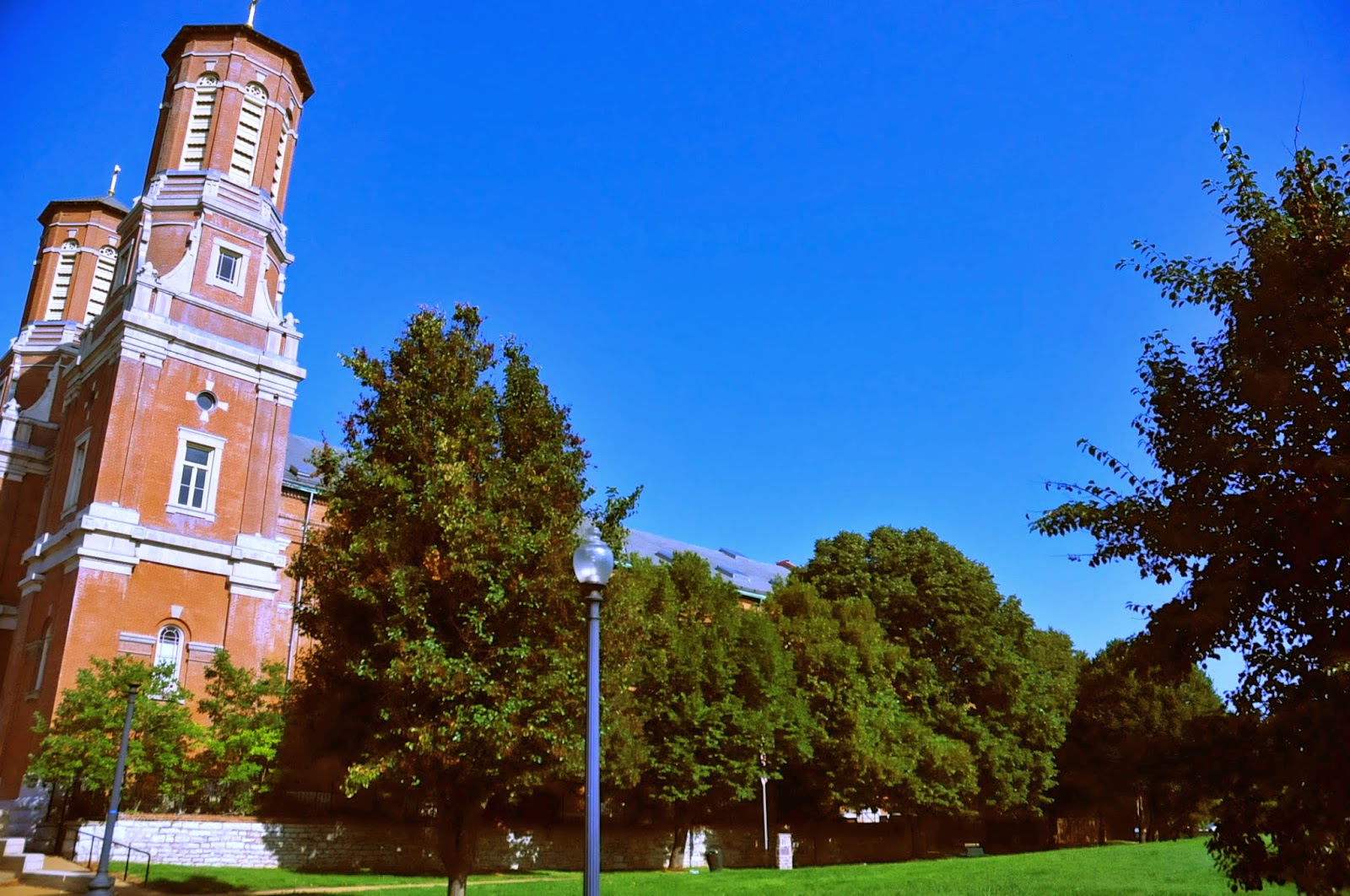
It is fitting to re-post some of the information about Fr. Filipiak from that previous post as he was the one person who saved the church from the Archdioscese wrecking ball (a mighty and still active wrecking ball indeed):
In 1979, the Rev. Edward Filipiak was a one-man pastorate on a mission to save his church, built in 1844, from demolition. Archdiocese leaders planned a new building nearby but backed off after some former parishioners organized the Friends of St. Joseph, and the National Register of Historic Places designated the twin-spire structure a landmark. (source)
Photo by Ted Dargen of the Post-Dispatch

Fr. Filipiak was sadly murdered in 1979 by a 16 year old who was caught stealing wine from the church.  Andrew Daugherty, the 16 year old murderer, only got 15 years for his crime.  In a tragic turn, Daugherty was later shot and killed at his mom's home in North City in the 5200 block of Lexington Avenue years later.  You can read the full story about the incident in a St. Louis Post-Dispatch article written in 2012.

What you'll see at this park is a grassy knoll of rolling berms and a few shade trees complete with benches and plaques in honor of Fr. Filipiak and those who've lost their lives in the line of work.


 bench repairs needed

 Edward Jones Dome and Arch in the background


There is a nice line of knockout roses along 9th street framing the park quite nicely and giving it a peaceful pocket park feel.


Monday, August 25, 2014

Tambo Park

Okay, in visiting and blogging on all 108 St. Louis parks I've come across another mystery.  The city website lists Tambo Park, a 1 acre park at Rutger and Ohio Avenues in the Gate District neighborhood as being placed into ordinance in 1985.

Google Maps has it pegged here:


This one is hard to get to and is only accessible from an alley between Caroline which is butchered mid-block and Rutger Street.  The street grid has been substantially mangled in this part of the city, so it is really hard to get around in a vehicle.  Once I finally found this place, all that is visible is this:

What can only be described as...a patch of mowed grass/weeds.  The mystery continues as per city records from fiscal year 2012.  There was $160,000 in improvements ear marked for Tambo Park:

TAMBO PARK
PLAYGROUND RENOVATION
$100,000
6


REPAIR MULTI-PURPOSE COURT
$45,000
6


REPLACE PARK BENCHES
$15,000
6
$160,000

Here's my source. As you can see, there is no playground, multi-purpose court nor park benches.  So this one is a bona fide mystery.

This park doesn't appear to exist in real life, only on Google maps and the city website...

14th Street Mall Park

Per the city website, 14th Street Mall Park is a 1.27 acre park placed into ordinance in 1976.  Well, if all that is true, I certainly can't find it.  Of course, I found the amazing 14th Street Mall re-branded as Crown Square...but no park.

Here's the snippet on the park from the city website:
This park land runs along 14th Street between St. Louis Ave and Warren St. in the historic Columbas Square neighborhood. 
Secondly, the spot they are referencing is in Old North St. Louis, not the Columbus Square (sp) neighborhood.

If you want to see what Crown Square looks like, you can see some of my photos from 2010, here.

Rumbold Park

Rumbold Park is 1 of 108 St. Louis parks.  This 3 acre park was placed into ordinance in 1945 and is located near North Spring and North Market Avenues in the Jeff Vander Lou Neighborhood.


Named in honor of Charlotte Rumbold, superintendent of public playgrounds and recreation in the St. Louis Parks Department from 1906 to 1915.  That is just the tip of the iceberg in Ms. Rumbold's distinguished life.


Ms. Rumbold was an early progressive and activist and a straight up amazing woman.  Born in Belleville, Illinois (my beloved hometown) and educated in New York and Europe, she moved to St. Louis where she was a colleague of Jane Addams a fellow advocate and pioneer of urban playgrounds.  Rumbold's motto was, "If we play together, we will work together."  I love it!
The daughter of a successful physician, Charlotte Rumbold grew up well-educated and secure. Yet she knew from intense observation that too many of her fellow St. Louisans lived in unacceptable conditions: substandard housing, filthy streets, meager health and recreation services. Eager to make a difference, she compiled a report on housing conditions for the city’s Civic League, rallied support for public bathhouses, organized the enormous Forest Park Pageant and Masque in 1913, and supervised the neighborhood playground movement for the city. The list of her accomplishments goes on, and by 1915 she could look around her city and smile at the steady improvements to which she had contributed. 
In 1907, she was named the first secretary of the Public Recreation Commission in St. Louis.  In her new position, Ms. Rumbold summarized a report commissioned by the Civic League Housing Committee of forty-eight blocks of the worst slums in the city, which had been surveyed by graduate students from the Missouri School of Social Economy. Filled with statistics and interpretive text, her report focused attention on the appalling living conditions in the urban environment and sparked legislation requiring better standards for construction of tenements. 
Her successful work in St. Louis continued. She made a difference by gaining support for public bathhouses, organizing the city's large 150th anniversary celebration, and improving the city's parks. In 1914, the St. Louis Globe-Democrat named her the "best-known young woman in St. Louis." In 1915, however, she asked for a raise and was denied by the city's Board of Aldermen, on the grounds that "she is not a voter." (source and source)
This certainly didn't sit well with Ms. Rumbold, a known suffragette, so she resigned her position in St. Louis and moved to Cleveland, Ohio of all places.  In Cleveland, she worked for the next 30 years or so to remove slums.  This story of progressives being beaten down by their time and place in industrial age cities is fascinating to me. I hope to do a separate story on Charlotte Rumbold in the future.

Read all about her life in St. Louis here.


That's where the fun ends on researching and visiting this park.  Well, if you want to see the open drug and prostitution trade this is your place.  Ever seen the Wire?  This is the STL version of those Baltimore scenes of street drug use/sales. Scales on playground equipment, drive thru pickups, not good, not safe.  Sorry, some places are not so nice.  This is one of them.   I'd be lying if I didn't mention this.  When ever I have a negative experience as I did here, I go back a second time to see if I just caught the park on a bad day.  Nope, I confirmed it on 3 separate occasions which to me is enough to call it like I see it.

As I was writing this, I read of a Aug 23rd, 2014 murder that occurred in front of the park on the sidewalk along Spring Avenue and another woman was shot while in the park.  Here's a snippet from the story in the St. Louis Post-Dispatch:
A 22-year-old woman told police that she was standing inside the park when she was shot by unknown males who began firing gunshots at several people in the park. 
If the neighbors don't stand up and put an end to this kind of stuff, it will go on and on. 

Here's what you'll see at Rumbold Park:


trash cans must be chained to poles or they'll be stolen and sold for scrap


Recycling dumpsters being used for yard waste blocking the sidewalks: 


It is a sad testament that through Ms. Rumbold's struggles to make respectful spaces for people to get a respite from the busy/dirty Industrial-Era city and this is how the current citizenry choose to treat the park.  

It's shocking to me that the police and neighbors don't work together to fight and put an end to this when it is so out in the open.  The squeaky wheels get the grease.

Sunday, August 24, 2014

Hickey Park

Hickey Park is 1 of 108 St. Louis parks.  This 16.26 acre park was placed into ordinance in 1947 and is located in the Baden Neighborhood just east of North Broadway right at Harlan Avenue:


The park was named after David Hickey, the first St. Louisan to lose his life in WWI.  Per the city website:
Dedicated April 10, 1941 and named in honor of David Hickey, the first St. Louisian who gave his life for his country in the World War in the Battle of the Toul Sector, February 24, 1918. (source)


St. Louis Post-Dispatch file photo

Tim O'Neil of the St. Louis Post-Dispatch did an excellent story on Hickey's involvement in the war and his impact on St. Louis; here are a couple snippets from that piece:
Hickey had grown up just north of downtown and was a newsboy. He later worked in shoe factories and the Post-Dispatch mail room, where newspapers were bundled. He played on local amateur baseball teams and never married. 
Hickey was the first of 1,072 men from the St. Louis area who died in uniform during World War I.
Read the full Post-Dispatch story HERE.
The current Hickey Park is the second named in his honor.  The first Hickey Park, established in 1941, was located at Goodfellow and Bircher boulevards. This park was dissolved when the parkland was taken to build the ammunition plant on Goodfellow for World War II. This was the factory visible from I-70.  I wish that factory was still around as a historical site commemorating St. Louis' domestic contribution to the war effort.  It was demolished in 2006.

photo source:  Built St. Louis

Per the Post-Dispatch story, the current Hickey Park was dedicated by Mayor Raymond Tucker in 1960.  This makes way more sense than the City website info which had the park dedicated in 1941, as the park on Broadway clearly looks post-war.

Today, the park is made up of a small service building with bathrooms, 2 playgrounds, a basketball court, several baseball fields (that look unused) and a walking path that circles the park with the commonly seen blue workout equipment at various stations.


During my visit, there was a guy walking the path and a few kids in football gear getting ready for a practice.

There is plenty of evidence that the park has been abused by its users.  

See for yourself:


 Hurt Em Badd 2000


The walking path is a sign of recent investment in the park.  Hopefully that will be the impetus to more positivity coming to the park in the future.