Walnut Park is one of seventeen branches in the St. Louis Public Library system.
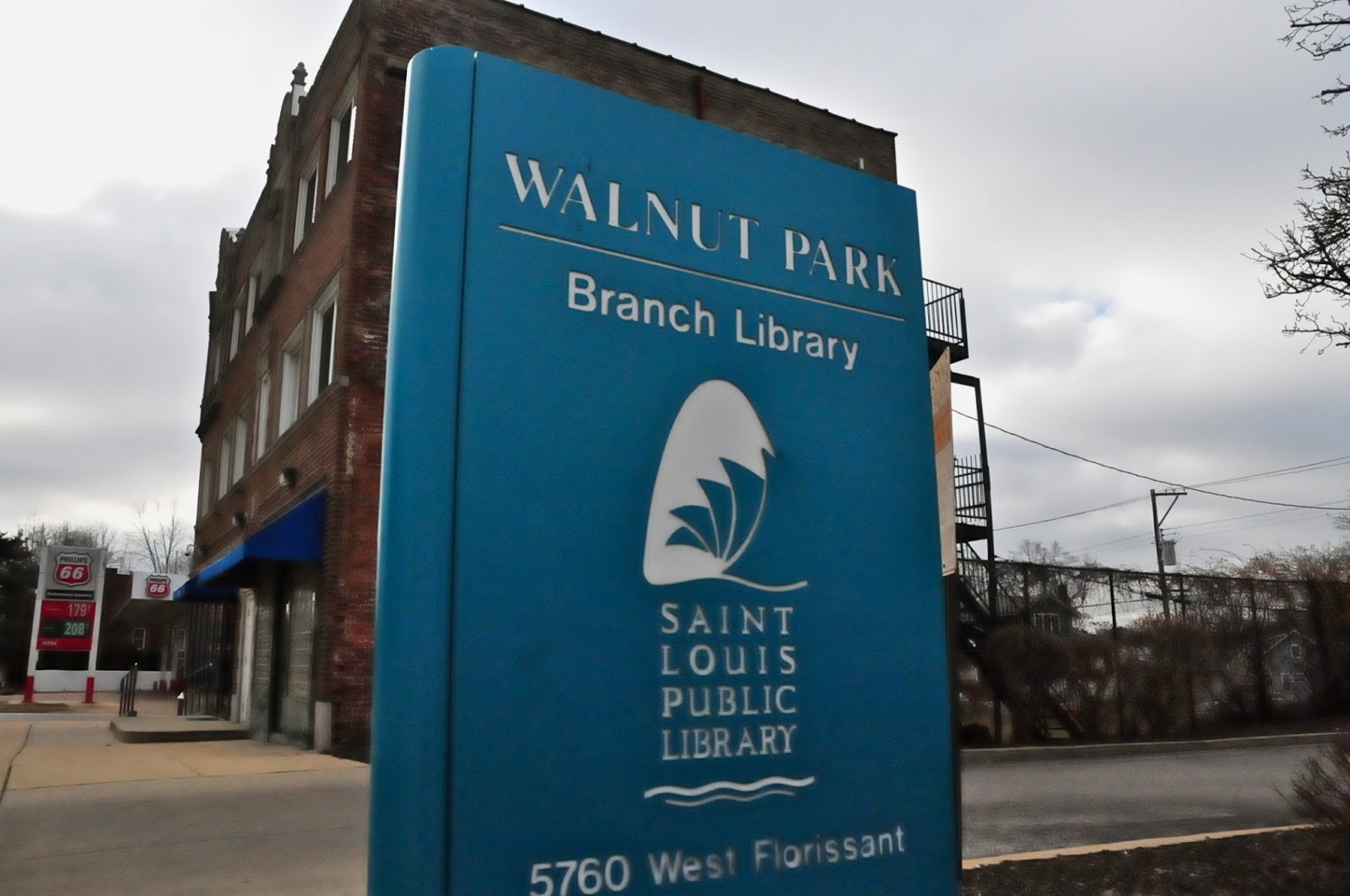
It is located at 5760 West Florissant Avenue at Gilmore Avenue in the Walnut Park East neighborhood. It is directly across from Calvary Cemetery.
It takes its name from the community it serves.

The Walnut Park branch dates back to 1917 when it opened as a sub-branch at 5553 Robin Avenue just around the way from its current location. The building was razed and is currently a vacant lot.
Here is a photo from 1920:

photo source: SLPL Then and Now
Then in November, 1928 the Walnut Park Branch relocated to 5778 West Florissant Avenue. Check out the difference in clothing from the people in the relatively well-to-do 1920's vs. the photo below from Depression Era 1931:
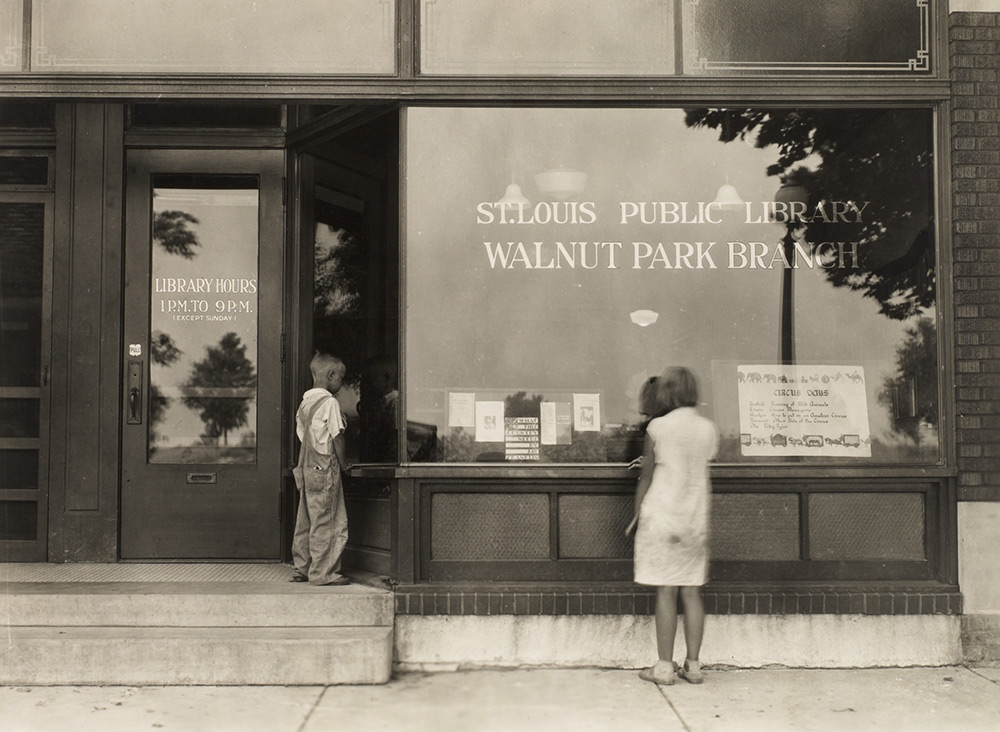
photo source: SLPL Then and Now
5778 West Florissant is still standing; here's a cropped image to match the photo above as well as a full view of the building.


The branch nearly moved to its third location in 1967 when a proposal was made to re-locate to 5240 West Florissant Avenue just east of Union Boulevard.
The library proposal for a site change was published, but quickly met neighborhood opposition:
 The source of neighborhood dissent was documented by the St. Louis Post-Dispatch on June 30, 1967 indicating that there was no public hearing seeking feedback from the neighbors and the proposed location was too high a traffic area and too close to taverns, resulting in unsafe conditions for children and elderly walking to the branch. While the proposed branch was only 6/10 of a mile from the then current location, the alderman, church community and a small group of ~100 residents leveraged enough of an argument to make the Library Board reconsider it's move.

In 1969 the Walnut Park branch settled at its current site at 5760 West Florissant Avenue. The site was selected with input from area residents and a standalone building was designed by architects Peckham-Guyton, Inc. and built by Pernikoff Construction. It opened in October, 1972.
The library proposal for a site change was published, but quickly met neighborhood opposition:


June 30, 1967 St. Louis Post-Dispatch article
In 1969 the Walnut Park branch settled at its current site at 5760 West Florissant Avenue. The site was selected with input from area residents and a standalone building was designed by architects Peckham-Guyton, Inc. and built by Pernikoff Construction. It opened in October, 1972.
Here's a photo from 1978:

photo source: SLPL Then and Now
And an architectural rendering:

And here's what it looks like today, where an addition was added and the former entrance on West Florissant was moved to the current east-facing entry:

the different colors of brick mark the addition

The October, 1972 opening followed a “book brigade” where a human conveyor belt of over 100 volunteers moved ~16,000 books from the old to the new branch building...in the rain. This amazing event occurred on September 23, 1972 and was well documented in the St. Louis Globe-Democrat and St. Louis Post-Dispatch. How can you not love that story?

 St. Louis Post-Disptach photo by James A. Rackwitz, 1972
 This goes down as my all-time favorite pic of my library adventure...
The exterior of the current location boasts wide sidewalks along West Florissant, allowing cuts for street trees.

St. Louis Globe-Democrat photo by Bob Diaz, 1972


The exterior of the current location boasts wide sidewalks along West Florissant, allowing cuts for street trees.

West Florissant has a dedicated bike lane, and there is a rack on the street in front of the library, as well as a rack on the library property.


The entrance is on the east side of the building off of the parking lot. There was a display in the foyer related to Islam in St. Louis.

The meeting room was setting up for a Dr. Martin Luther King, Jr. seminar.

Entering the library from the foyer, you'll immediately notice this branch has a great open and bright feel. It is spic-n-span clean, the walls are adorned with colorful artwork from kids. There is a fish tank that adds to the relaxed vibe.


There is a sizeable children's area and a "teen lounge".


There is a small nook in the building right off the personal computer room that looks out to a small community garden maintained by volunteers from the Walnut Park Community Garden Club. The Walnut Park Community Garden Club received a $250 donation from the St. Louis Garden Club in September 2015, thanks to the generosity of St. Louis Garden Club President Ulrike Schlafly. The garden was established by a grant from the Missouri Department of Agriculture in 2012:
Apparently, the inner court was once highlighted by a low-relief sculpture which extended from inside the building through the outdoor court. This does not exist today, and I will add this to my list of "Mysteries at the Library" to investigate at the Central Library.
There are mosaic glazed-ceramic sculptures affixed to the outside wall of the court. The ceramic motifs were designed by William C. Severson of Scopia Studio.

"Thanks to the vision of the Library’s Walnut Park Branch manager at the time (Rodney Freeman) —as well as the enthusiastic support of the Director of the Missouri Department of Agriculture—the Branch became the first recipient of a $2,500 grant from the Department of Agriculture to support its community garden. The garden’s mission was and is to educate individuals on the health and economic benefits of growing organic food and to enhance community engagement." (source)
Apparently, the inner court was once highlighted by a low-relief sculpture which extended from inside the building through the outdoor court. This does not exist today, and I will add this to my list of "Mysteries at the Library" to investigate at the Central Library.
There are mosaic glazed-ceramic sculptures affixed to the outside wall of the court. The ceramic motifs were designed by William C. Severson of Scopia Studio.


- Are there any photos of the "low-relief sculpture" that once went from the inside to the outside courtyard?


