Thursday, March 23, 2017

Follow Up Post RE: The Evening Whirl

So I recently stumbled across a St. Louis original, the Evening Whirl. The story is all right here.

Happenstance and the Whirl made it's way into my afternoon today when I picked up two Sprites and a bag of Skittles (don't judge me) and asked the gas station attendant for the Whirl.

I wanted to read another issue to follow up with a little extra observation to make sure I fairly wrote up a summary of my firsthand experience reading the publication. Multiple replications make for good science and sound statistics (and better blogs).

She pointed me to a stack of the Whirls, rang up the bill and gave me a weird look. "It's three sixes (666)", she said.

Sure enough my bill was $6.66.

We both kind of chuckled, and I said something like "yeah, three of a kind is good but not with sixes."

She kinda shook off that awkward rebuttal and said, "no you asked for the Whirl, then you got 666."

Read: a) not good luck for you or b) "don't let me see you in the Whirl."

Sunday, March 19, 2017

Historic Codes, an Empty Lot and a Proposed Mosque In McKinley Heights

I attended the Fox Park neighborhood association meeting this past January and was pleased to find an agenda jam packed with topics and speakers. It was exciting to just sit back and listen to all that is going on in my neck of the woods. There were politicians running for offices, not-for-profits speaking to new and exciting projects, and volunteers working their tails off to make Fox Park a nice place to live.

One of the guest speakers at the meeting was Rocco Danna, the McKinley Heights Neighborhood Association Chair of Development. McKinley Heights is the neighborhood directly to the east of Fox Park. The neighborhoods are very similar, especially in that they are both historic districts. We both have the same challenges and assets. We are good neighbors.

Danna came bearing good news...at first, followed by a plea for help in honoring the historic codes of the neighborhood.

First the good news:

There are plans for a mosque to be constructed by the Qooba Foundation at the corner of Jefferson and Allen Avenues in the McKinley Heights Neighborhood.

This is exciting and promising as this corner has sat vacant for many years. In fact, you have to go back to the 1970's to find a historical aerial photo of the site to view the buildings that existed at this corner.

The following photo from 1958 gives you a good idea of what the historic buildings looked like before they were demolished.
A dense, urban city we once had. Not so today as the corner buildings were razed and the lot has been vacant for years:
The properties under discussion here include 2008 South Jefferson, which is a cool old building that is owned by the same organization (Qooba Foundation); there are no plans to raze this building (whew!). Qooba also owns 2326-2346 Allen Avenue, the corner with the mosque proposal.

Here's what the two properties look as of publishing:
2008 South Jefferson Avenue 
2326-2346 Allen Avenue

These are complicated properties in that are unsightly at best, irresponsibly maintained at worst. The ownership of the 2008 Jefferson building has been stable since Qooba Foundation purchased it in 2012 from an Oakville, MO owner. The corner property has changed hands six times since 2003. Owners have ranged from the suburbs in Illinois and Missouri, to St. Louis owners. Most recently Qooba Foundation purchased it from Muhammad Qayyum of Valley Park, MO in 2012/13. This is when the property was removed from the tax books since Qooba is a religious organization. It collected $2311.76 in property taxes in 2012.

So obviously, the property will be exempt from property taxes.

This long history of property changing hands multiple times with no development has led to the area being a bit of an eyesore for people who live here. The St. Louis Citizen Service Bureau has received a combined 77 individual complaints, most for graffiti, illegal dumping, overgrown weeds, etc.

The evidence of neglect is clearly on display as of publishing:
Bottom line, this long abandoned and neglected property is poised for possible new life and that is truly exciting.

The fact that the site proposal is a mosque is good news as well. St. Louis has been welcoming to the Muslim community in my experience living near the large Bosnian population near Bevo.  In fact, the only minaret in St. Louis is located in the Bevo Mill Neighborhood. It adds to our soul and interest as a city. As the world evolves, so does St. Louis.
Minaret in the Bevo Neighborhood

And, since I've lived in the Fox Park/McKinley Heights area for over seven years, I've come to appreciate how welcoming people are around here. And I don't mean in a fluffy, fake, on the surface way. I mean it is real...as real as it has been in my life anyway.

The Qooba Foundation will be nothing but accepted here, just like the Scientologists a block or so north of here and the scads of little (mostly African-American) Christian churches of so many denominations I can't keep track. Everybody seems to get along when it comes to religion in these parts. There is even a Serbian Orthodox church in McKinley Heights that has one of the best fish fry's in St. Louis...they are considered by many to be a pillar of the neighborhood.

The Church of Scientology is investing heavily in their building at Jefferson and Lafayette which they purchased in 2007 for $1.6M per city records.

This building which opened in 1928 used to house a German cultural center called Das Deutsche Haus, the building later was home to the St. Louis Symphony Orchestra in the 1950's and eventually carried the St. Louis House name and was home to two Christian schools before it was boarded up for the last 10 years or so (source).

The Church of Scientology just got a $200,000 permit to replace the front stairs to this beautiful building. It is good to have them in the area and investing in this historic building that adds so much character and context to a great part of the city.
Proof positive that churches and other non-profits are welcome and are investing in our neighborhoods...even the ones in historic neighborhoods. It's good to have them. No one, I mean no one has ever said or implied anything negative about Muslims in my conversations on this topic. Ever. If they did, I'd speak up.

But that's where the good news hits a snag with the mosque proposal...the site plan proposed is not good. In fact it is horrible. It doesn't match a historic neighborhood, or follow the established rules and codes in any way.


The parking is placed on the perimeter so pedestrians see nothing but cars or empty paved asphalt from Allen and Jefferson. The mosque is set back from both streets.

And most of all, it makes the same mistakes that countless churches have made in the central and northern sections of St. Louis...a small church surrounded by a sea of parking that gets used for mere hours in a week. This suburban design steals the urban fabric, soul and connection to its surroundings.

I'll provide an example so you can visualize what I'm describing and where my concerns lie.

Lately, I've spent a lot of time around one of my kid's high schools in Midtown. Adjacent to the school is just one example of the damage that a single bad site plan, allowed to ignore urban standards can destroy a block for all who want to live in a city.

And please, please don't crucify me for my choice of this particular church...I had scads of choices, especially in North City, where land is crazy cheap and churches bulldoze multiple parcels for massive surface parking lots and sprawling one-story suburban buildings. But I wanted to use a popular part of town that most people know.

McPherson and Vandeventer:
Again, this is not a shot against the Church of Jesus Christ of Latter-day Saints or any other denomination or religious organization, they are all welcome and that is why it's important to make sure they are good neighbors who add to our city vs. cut it up and block it out from anyone who is not a member.

Here's a view of the dead space created by massive parking lots, suburban site plans and fences to keep people out.
 de-activated street corner at McPherson and Vandeventer
 massive fenced in surface parking lot 
 gates for members only access
 largely empty lots ~6 days a week
 half a block completely fenced off from the city/pedestrians
 fences say: "keep out"
Watch this < 30 second video of how inhospitable this street is from a pedestrian standpoint:
Places of worship should be interwoven into our neighborhoods, flowing together and cohesive with the resident's homes. Our forefathers got this. Just look at our historic neighborhoods...churches flow like just another home or business. And McKinley Heights and other historic neighborhoods have gone to great lengths to defend this historic stock.

That is why rules are in place and regulations have been established...to prevent erosion of our urban fabric. This can't happen in our dense neighborhoods like McKinley Heights and Fox Park.

Furthermore, people buy buildings, homes and businesses in historical neighborhoods because they want urban fabric. There are protections in place to protect their investment in our history...and provide a system to review and work with new construction so it fits in and respects the original craftsmanship we are blessed with.

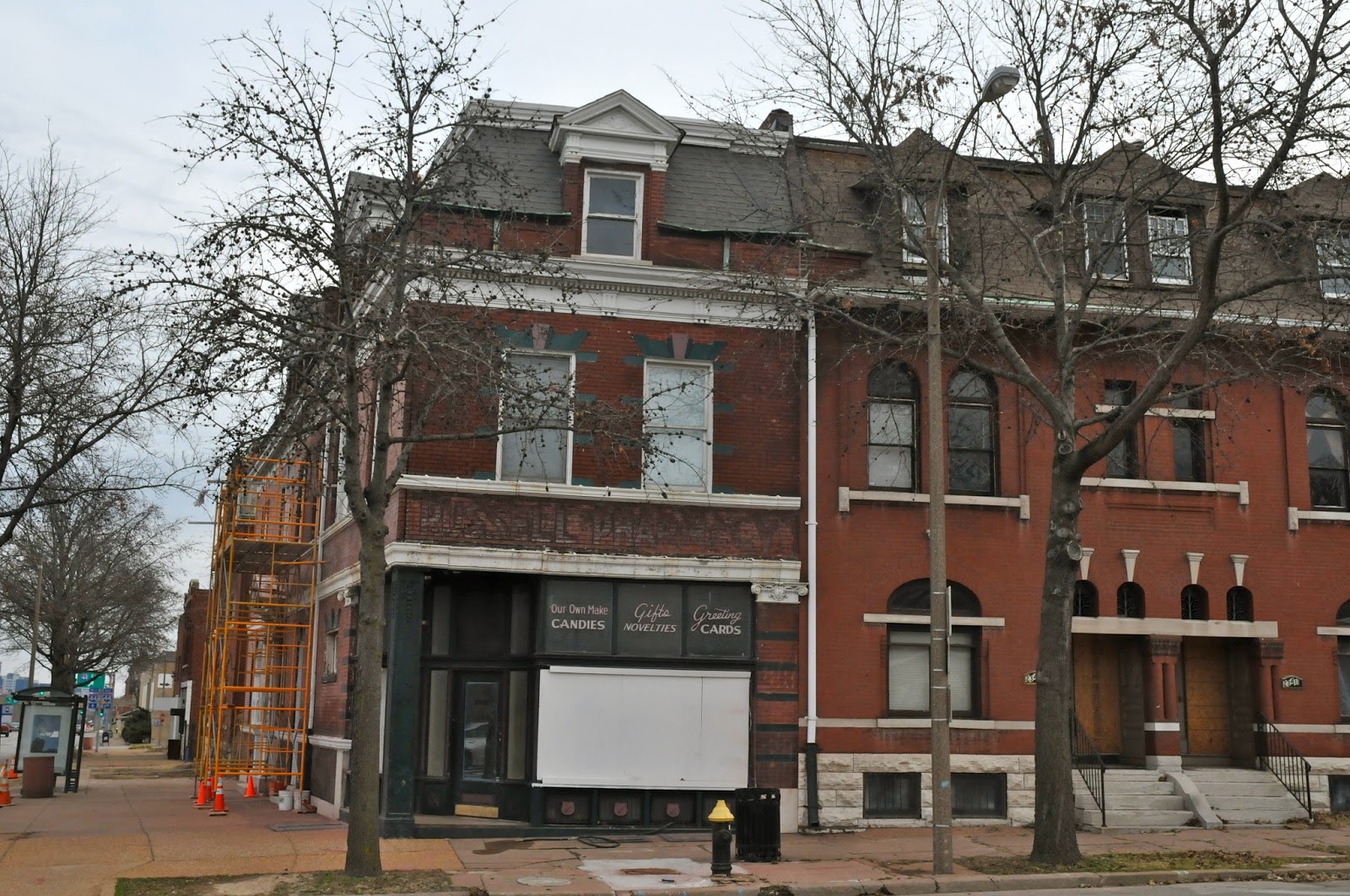
Just a few steps south of the mosque site is the perfect example of someone spending tens of thousands to tuckpoint and renovate a beautiful historic building that has been long vacant.

Their investment would be sorely discredited by the suburban site plan that has been proposed at the other end of the block. Take a look at the massive amount of investment going on at the corner of Jefferson and Russell:
We simply must respect the investments and commitments people are making to our housing stock. We have to do better than what is being proposed at the corner of Jefferson and Allen. The site plan which is completely suburban  with deep setbacks from the streets, poor, cheap design surrounded by surface parking (which could easily be tucked behind the mosque).

And, as the Post-Dispatch reported in January, 2017, the Cultural Resources Office of St. Louis even proposed...get ready...an eight-foot wall surrounding the property. From the official report:
In view of the unusual siting of the building, the staff recommends the construction of a brick wall at the property lines of Jefferson and Allen to continue the building lines of the block. The applicant has expressed concerns about vandalism and graffiti with the construction of a wall. (source)
What?  You can't make this up. The neighborhood has to show up at these meetings to fight this kind of thought by the city. From the Post-Dispatch article:
The Cultural Resources Office report had urged construction of a brick perimeter wall next to the site’s sidewalks to screen the parking from view and to continue “the building lines of the block.” 
Members of the mosque’s congregation and neighborhood residents agreed Monday that the recommended 8-foot-high brick wall was a bad idea. 
Tim Kaminski, Qooba Foundation’s president, told board members such a wall would likely be a target of vandals. Other congregation members said they preferred a lower wall or no wall. 
Rocco Danna, a member of the McKinley Heights neighborhood association, agreed the wall plan was unwelcome but said the mosque site should be changed to make it more compatible with the historic area.
Read that again, the city recommended an eight-foot -high wall surrounding the property.

The McKinley Heights Historic District has enacted design standards to provide protections against such poor suburban design. The full document can be read HERE.

Here are some key elements of the historic codes that are violated with this initial site plan from Qooba Foundation:

501.1 Height   New buildings must be constructed within 15 percent of the average height of existing buildings on the block. Any additions must be compatible with both the existing building and the surrounding structures.   

501.2 Scale   The scale of all proposed new construction in the Corridor must respect the existing scale of any surrounding historic structures by seeking to minimize the difference in height, mass, fenestration, and location. Any additions must be compatible with both the existing building and the surrounding structures.


501.4 Exterior Materials   All new building materials shall be compatible in type and texture with the dominant materials of adjacent buildings. While artificial masonry such as "Permastone" is not permitted, introduction of new materials for new construction will be considered. A submission of all building material samples shall be required prior to approval. Any additions must be compatible with both the existing building and the surrounding structures. 

504. Parking   All off‐street parking shall be located behind or to the side of commercial structures. Where visible from the street, screening with visually opaque landscaping or 5' minimum high masonry or concrete wall shall be necessary. Visually opaque landscaping is defined as a continuous hedgerow of bushes planted 36" on center within a planting strip at least 5 feet wide. The planting strips with hedgerow must also contain upper story shade trees planted every 25 feet along the planting strip. The trees must be at least 2 1/2" in caliper upon plating.   All parking lots over 5,000 square feet in surface size must also be landscaped on the interior with tree planting wells, at least 15 square feet in size, so that at least 3% of the interior is landscaped with upper story shade trees at least 2 1/2 " caliper upon planting. 

Look at the comments from the Cultural Resources Office which states the section from the historic code and then the city's comments in bold font.
501.1. Height  New Buildings must be constructed within 15 percent of the average height of existing buildings on the block..... 
The building will be shorter than some surrounding structures due to its unusual design requirements.
501.2 Scale The scale of all proposed new construction in the Corridor must respect the existing scale of any surrounding historic structures by seeking to minimize the difference in height, mass, fenestration, and location. Any additions must be compatible with both the existing building and the surrounding structures. 
This is an unusual property type whose program will make it difficult to conform to the scale of surrounding buildings. The use of brick as the exterior material will create a relationship with adjacent buildings.
501.4 Exterior Materials All new building materials shall be compatible in type and texture with the dominant materials on adjacent buildings. While artificial masonry such as “Permastone” is not permitted, introduction of new materials for new construction will be considered. A submission of all building material samples shall be required prior to approval.... 
The applicant has made significant design alterations based upon staff recommendations. The use of brick as the primary building material will be instrumental in creating a design relationship with adjacent buildings. 
504 Parking  All off-street parking shall be located behind or to the side of commercial structures. Where visible from the street screening with visually opaque landscaping or 5’ minimum high masonry or concrete wall shall be necessary. Visually opaque landscaping is defined as a continuous hedge row of bushed planted 36” on center with a planting strip at least 5 feet wide. The planting strips with hedge row must also contain upper story shade trees planted every 25 feet along the planting strip. The trees must be at least 2 1⁄2” in caliper upon planting.  
This proposal includes parking in front of the mosque at the corner of S. Jefferson and Allen. At minimum the McKinley Fox ordinance calls for opaque landscaping screen or a masonry or concrete wall to screen such parking from street view. 
This is not defense of the historic code, especially the city's response to 501.2. This is not some unsolvable puzzle. This is a simple site plan that must match it's neighbors. This plan does not in any way add to the neighborhood as it is proposed. 

It needs to go back to the drawing board to find an equitable solution. This can happen where all parties are happy. Compromise and negotiation must occur.

But why isn't the city doing it's job? Cultural Resources is supposed to be the protector of the historic code, yet they came out against the code itself. This had to be a surprise to the the Neighborhood Association who assumed that Cultural Resources would be objective. 

You can watch the entire meeting here:

Again, from the footage in the review board meeting, it's great to see how welcoming the neighborhood is of a mosque, but that's where the support ends. The wall that was proposed was the main topic of conversation and backlash.

But Mr. Danna spoke at the 39:13 mark of the video to the fact that the neighborhood is not willing to abandon the historic code to accommodate this suburban design and street setback (my words).

Per my take on the presentation of the Qooba Foundation to the preservation board, this is all about parking. They want a large parking lot out front not tucked behind the structure like it could/should be. They are willing to move away from the idea of a wall, but the parking is the key for them.

The basis of their claims for the suburban setbacks were youth safety and safety of people getting in and out of cars.

Safety is everyone's concern. As Danna mentioned in his testimony, just across the street is the SouthSide Early Childhood Center who has a Monday through Friday need for child safety...parents dropping little ones off constantly. SouthSide ECC built an urban building with respect to our neighborhood. This is not hard to do.

Proof:
So why is the Qooba Foundation not held to the same standard? Why would this site be exempt from the rules and codes?

This is not acceptable, and this story that is unfolding is an example of how the city's street grid and character of its historic neighborhoods gets chipped away by lazy site plans and even worse, a complicit city Preservation Board/CRO.

We can't let this happen.
 
Any architect with experience working within neighborhoods with historic codes could creatively meet the needs of the customer (Qooba Foundation) and the neighborhood code...within budget.

I learned that a mosque's prayer room has to be designed to face Mecca. This is not a show stopper for a good site plan either...some would see this as an opportunity to build a memorable addition to a prominent city corner. As Danna states in his testimony, there are ways to make this work.

And, this is a prominent corner. Remember, there are plans under discussion to make Jefferson Avenue part of the North/South Metrolink or streetcar line.

We cannot let this suburban site plan go further. Just like any property owner, especially ones who won't pay property taxes, you have to work within the rules that exist to protect the majority's investments and desires for a historic neighborhood.

The full Qooba Foundation proposal may be accessed HERE starting on page 19.

So what's next? Well, despite the neighborhood's objections (see youtube video), the design passed Preliminary Review at the Board. The city is saying McKinley Heights cannot appeal a Preliminary Review. Curiously, preliminary Approval was given without a quorum. According to the by-laws of the Preservation Review Board you do not need a quorum for a Preliminary Review. Only 4 of the 9 members were present at the Review. The mosque has two years from passing the Preliminary Review to get a building permit. At that time an appeal could be issued by the Neighborhood Association. Or, the proposal could go back to Preservation Review Board for final approval; and if the development is granted Final Approval an appeal could be made there.

This lack of support of the Review Board is disappointing as a person who moved here for historic stock and respect for preservation. 

Not only do you have to fight the owner's proposal, you have to fight the city to uphold the codes.

This kind of disregard to follow the codes and rules makes it a fight that requires volunteers and concerned citizens to spend many hours strategizing on how to protect the code, getting petitions and signatures to validate popular opinion, go to meetings during normal working hours, fight the city and try to not let such suburban design proposals so present in our region and country to creep into our historic neighborhoods.

Let's work toward an equitable solution. It'll need compromise and negotiation. It'll take all parties to be reasonable and just. I know this can happen.

Thanks to the Qooba Foundation for choosing our part of the city to root down. Please continue to work within the historic codes to build a mosque and parking lot that complement the corner and add to our rich history....not stand out like a sore thumb. Don't fence us off. Don't wall us off. Don't hide the mosque behind a sea of surface parking bring it to the corner where it belongs!

Again, look across the street at SouthSide Early Childhood Center. This site used to be a suburban Taco Bell drive through. They elevated our neighborhood and chose to be good neighbors and respect our historic urban form.

Thanks also to the McKinley Heights Neighborhood association for leading the charge to protect the code and the neighborhood.

I will be following this one closely.

Saturday, March 4, 2017

The Evening Whirl - My Path To Discovery

Seems with many things, I'm late to the party. And just discovering the nearly 80 year old African American owned and operated Evening Whirl is the latest example.

Here's how I stumbled upon this local newspaper. 

My drive time to and from work has recently been filled with podcasts to pass the time and keep the brain stimulated.

"Criminal is a podcast about crime. Stories of people who've done wrong, been wronged, or gotten caught somewhere in the middle." (source)
New York Magazine sums it up when they wrote: 
“Criminal is a true­ crime podcast that understands crime as something sociological, historical, even anthropological — that crime is a function of people, time, and place. With incredible sound design, marvelous writing, and a boldness in the way it makes its choices, there are few shows that feel more alive.”
It's really thought provoking and helps you consider both sides of crime, victim and perpetrator. It has helped me come to grips with life in St. Louis. 

So you can imagine how excited and surprised I was when Episode 56 came about, titled:

"Don't Let Me See You In The Whirl"

The episode description from Criminal Podcast:
"Since 1938, a weekly African-American owned newspaper called the Evening Whirl has covered crime in St. Louis with a style all its own, using alliteration and rhyme, and often omitting the usual crime-reporting words like "accused" or "alleged." The paper has been widely criticized for its casual approach to fact-checking and sensational writing style. But the paper's owner, Anthony Sanders, who has been helping out with it since he was 18 years old, doesn't have any plans to change it. As the pages of The Whirl have said:  "If that's too much for you, pick up the Times and read the theatre reviews."
A great episode, the host, Phoebe Judge, flew to St. Louis to interview Sanders. They met at Culpepper's.

The Whirl's founder Benjamin Thomas started the paper in 1938 and retired in 1995 when Sanders took over. Thomas died in 2005 at the age of 94 (source). There are plenty of great interviews out there with Thomas. Do yourself a favor and watch these two interviews with Peter Jennings and Arsenio Hall:
The history of this local paper is important. Thomas founded the paper in the Jim Crow era when blacks and black issues were not reported on or recorded. Obituaries were not printed in the newspapers. 

The topics discussed in the podcast included the tone of the reporting which is less clinical journalism and more prose ripe with accusational tones...no "alleged" or other soft language here. They go straight to the core and spice it up with some real talk or opinion...you are guilty and shamefully took someone life.

They discussed the playful manner of the wordplay in each article, and Sanders says it is this wordplay that adds the spice that make the meal, not the base ingredients...the spice is what makes the meal memorable or good.

They talked about how police are always the good guys and criminals the foils. Apparently the paper is read by police and the criminal set as well. The police use the Whirl to help them piece together the activity on the streets. Sanders claims that if you are going to solve a crime you have to "put it out there". Talk about it, shame it, get people to want to talk about it (snitch) and have the desire to stop the violence.

The Whirl is one such flashlight shining light on the underbelly.

Sanders says the Whirl is a place people go to read "who did the stupidest stuff this week" and people want to know if they got in the Whirl. It's a badge of honor for some in the region.

Sanders also spoke to the fact that the paper has been criticized over the years with plenty of libel lawsuits and charges of racism. This is obviously a complicated claim since the paper has always been owned and operated by African-Americans. Sanders said there is criticism from the black community that the Whirl only report on black crime...he says this claim is patently false. He said "no homicide is not reported on"...regardless of race.

The local chapter of the NAACP boycotted the paper in the 1980's claiming it exploits African-Americans. Sanders disagrees. In fact the Whirl is one of the only documents to record what has happened in the AA community in St. Louis. Nearby Washington University is preserving and studying copies of the Whirl to understand portrayals of race, drugs and guns in St. Louis...and America. In some cases the Whirl is the only document of gay African-Americans in front of and behind the guns.

The Whirl doesn't avoid these topics. Race, look, lifestyle, descriptions of the lack of dignity are not described in the Post-Dispatch...the Whirl is rich with description. The Post reads like a legal document, the Whirl a salacious true crime account.

The history of the paper was also discussed on the podcast. While it is not 100% clear, the name of the paper has a couple theories. Sanders says the whirl represents "kicking up dust". Ms. Judge posits that there is a line in Mark Twain's "Guilded Age" that reads: "Both chatted away in high spirits and made the evening whirl along in the most mirthful manner."

With Twain's roots here and Thomas' love for playful, humorous and rhythmic prose, the connection has legs.

The publication is wildly popular in the black areas of town.  Sanders claims that readership has grown from 4000 to nearly 55,000. He should know, he personally delivers the papers which "sell as good as the Post (read St. Louis Post-Dispatch) in some areas". They even hired a reporter...

For now the Whirl is here to stay and there is no shortage of material.

The interview ends with a passage from the Whirl from 1978 and an example of how the Whirl has entered the local colloquial farewells:

"Guns will roar and rip like hell and how the Evening Whirl will sell."

So when saying goodbye, people say "Don't let me see you in the Whirl" as they bid farewell to friends and family.

Thanks to the Criminal podcast and Ms. Judge for coming to St. Louis to shine a light on our local culture and history.

Now for the personal part of the blog...

I wondered why I hadn't seen or heard of The St. Louis Evening Whirl. Then, I was filling up my tank at a BP on Jefferson Avenue and there it was right on the counter in a nice little stack. I bought my first Evening Whirl, Volume 79 No. 12.
It is not a tome, it is printed on four pages, front and back. It is a quick read.

Some of the headlines in my maiden voyage through this historic black paper:

"Teen arrested in murder of grandpa visiting Gustine"

"Off-duty cop ok'd for whacking intruder"

The tag line on the top of the paper reads: "There is power in naming and power in shaming!"

Shame it does...or speak the truth depending on your perspective. It is unfiltered like the way people talk when they are together commiserating over the crazy stuff that goes down in this town.  It is sensationalistic and sing-songy vs. factual and dry like mainstream journalism.

There are tip lines and photos of the most wanted in the area still walking the streets. The Whirl is a member of the public safety council of metropolitan St. Louis...they want to fight crime and call out the horrible things people are capable of and that is how the reporting reads.

But it's not all just crime my friends, there is more. 

The "Inside The Whirl" center section has lots of hip hop music news and free announcement space for local events and shows in the black community.

There is a great "Ask The Leading Ladies" section where readers write in questions about dating, relationships or enhancing your sex life.  And...AND...a separate section "Dr. Feel Good" where readers from the city and county can ask candid questions related to sex. 

There is also Asset: Girl Of The Week with a small photo spread and profile of her background, online info, likes and dislikes...worst pickup line she's experienced, etc.

I'm now educated in the ways of the Whirl. I feel one step closer to being a true St. Louisan. 

Long live the Evening Whirl.

Thanks for adding spice to the St. Louis soup. 

Sunday, February 19, 2017

Charless Village Update - McKinley Heights Neighborhood


It was a fun blog for me because it started with simple curiosity of a CF Vatterott housing development called "Charless Village" on an empty lot. But, it evolved into a deeper understanding of St. Louis' past and present. Once I started poking around, I figured out this was the site of a former SLPS school, Charless School.
One thing led to another and I found myself on the Charless School alumni Facebook page, which brought exchanges with folks with firsthand knowledge of the school.

Then, one of our best reference librarians in the city stumbled across the blog and helped me track down the closing date for the school, and verify the fact that the school was indeed named in honor of Joseph Charless and was damaged by a tornado in 1896.

This beautiful school was operational from 1895 to 1981. Arsonists provided the final blow in 1988 setting a 3-alarm fire in the school...it was razed in 1993 and sat as an empty lot until 2016.

Arsonists can prove to be a stronger force of destruction than even the worst tornado that Mother Nature brought to St. Louis...so it goes.

Anyhow, it was a fun post where history unfolded and I got lost in it for awhile.

I chose to go back to check on the progress.

So here's a chronological set of photos that takes you from the property as a vacant lot in June, 2016 to the current state in February, 2017:


Google street view Image from June, 2016

November, 2016 from Shenandoah Avenue
November, 2016 Alley View
 February, 2017, old meets new on Shenandoah Avenue
 February, 2017, Shenandoah Avenue view
 February, 2017 alley view
Future parking off the alley

So opinions and thoughts on new construction in our historic neighborhoods, such as McKinley Heights can be lively and quite varied.

I will hold my cards close to my chest on my personal opinions until this project is finalized; but to date, I have to say I'm optimistic.

The street grid is respected both on Shenandoah and the alley. Parking in the rear makes a huge difference for quality of life in this part of St. Louis...these will have it. The massing, the subtle yet varied styles/forms and relationship to the awesome buildings on each side is respected. So far so good, I'll revisit upon completion and weigh in on the finished product.

Will these be market rate offerings? Will there be demand and will they be purchased quickly? 

Stay tuned. 

Thursday, February 9, 2017

Some Quick Thoughts On An MLS Stadium


Well, I guess the electorate of STL is all of a sudden respected. If you recall, we were decidedly not thought to be worthy of voting on the Rams stadium debacle (check the record on the aldermen who voted for that mess...and who are running for office).

Now remember, if you live a couple feet west of Skinker Boulevard, a few feet south of the River Des Peres, a few feet west of Cement land or a few feet east of the halfway point on the Stan Span, you don't matter in this conversation. 

If you are a suburbanite, you are not being asked to pay for an MLS stadium. You are not being asked to pave a massive expanse of land in your city for surface parking lots that get used maybe 20 days a year. And most importantly, you don't get to vote on whether STL gives ~$60M in tax money to pay for a MLS stadium. 

You are irrelevant if you don't live in STL when it comes to an MLS stadium. 

Why? Because the suburban cities in the areas surrounding STL don't want anything to do with giving public tax dollars to the prospective MLS ownership group (who I'm almost certain don't even live in STL).

There is no regional taxing district for sports arenas. Outside of the ZMD and GRG initiatives, there is little desire to share in this region.  STL is expected to carry the weight on regional issues, both ones the county people want and of course the ones they want absolutely nothing to do with. For instance, can you imagine the county taking an equal part in caring for the homeless, the growing population of elderly on fixed incomes or oxy/heroin/meth/crack/booze addled members of our region? 

No, these are STL problems. We are expected to take these things on...and of course the stadiums/parking lots for hockey, baseball, soccer and any other sport you can imagine.

I'm feeling cynical lately, forgive me. I just don't think people like County Executive Steve Stenger want anything to do with STL. And sadly, I feel he's the voice of the angry people I hear in the burbs who hate STL and it's problems both perceived and real.

But a vote on an MLS stadium is coming up (if you live in STL)...and what American doesn't love a vote?

I take a vote very seriously. I try to do my best to educate myself, be fair, compromise and think of the greater over my selfish interests.

But this MLS ownership group has asked ONLY STL for tax $ to pay for their stadium. Their... Who is they? I'm not sure I can put a face to the names. I'm not sure I've met them or seen them at any neighborhood meetings of public forums in STL to drum up support and make us want to support them.

Who are these guys? Will I know by April when I get to vote on this $60M or so of our hard paid dollars.

Imagine an alternate past where this MLS ownership group showed themselves before they made the ask. Sure they are likely staunch county boys, rich kids all grown up and successful and connected. Good for them. But they're probably genuine, well-meaning people. We are all reasonable Midwesterners, no?  Heck, STL people loved the Busch family well after they left for Sunset Hills and Huntleigh and other areas outside of STL...even in the post-In-Bev days, we still seem to love them.

When will this ownership group let us know how much they love soccer (their last pitch was for NFL football) and apologize for not introducing themselves earlier.

It's been too long, guys.

St. Louis is a small town (~300K) and most people know each other, or at least recognize each other. But few in STL know these guys...at least the people in my small hoi-polloi circles.

What if they acknowledged the huge ask of $ they were making on us. What if they acknowledged the need for strong schools and crime prevention in STL, yet made a convincing pitch for their investment in a team and stadium we would (by default) own? 

What if they threw us a bone for our vote?

What if they signed a city contract to donate money/build three quality soccer fields in STL for the CYC and SLPS to use. (currently there are 0). What if they committed to aerate, seed and water said fields for 30 years? What if they vowed to pay for SLPS/CYC/Charter school soccer coach/referee training programs?

If you think soccer is big in St. Louis please come witness the fields the CYC league plays on. Please come with me and walk the fields the SLPS high school league plays on. Let me show you the field one of the greatest middle schools in the country practices on. Let's meet the soccer coaches in St. Louis and see what they want/need.  

I've heard nothing like that...just that we're dumb and missing out on this amazing opportunity to build a stadium. Um, we've got 3, two with teams in them...and they are just not helping us gain residents and money. Check the stats guys.

The 100 or so cities in the suburbs outside of St. Louis have a rich history investing in soccer programs and fields. Look no further than the impressive soccer park off of I-44 just west of I-270. St. Louis has nothing like this. Nor does St. Louis have plans for anything like this. We have bigger fish to fry. We're not at the stage of building soccer field or rock climbing in our schools or neghborhoods yet...maybe you guys could help us.

But these regional leaders/investors who don't live here or care about crime/schools/neighborhoods here want our public money and are willing to give up none of theirs.

Float me a plan that makes sense. Throw me a bone. Give me some reason to believe. I'm a taxpayer, a resident, a dad, a voter in St. Louis...the one city in this 2-state, 100 or so city region that will decide the fate of soccer for now.

As of now, this ownership group has given St. Louis people very little to grasp onto. 

Memories of Kroenke and the great County rulers so close but yet so far from St. Louis are swimming in my mind.

I'll remain a skeptic until this group of investors shows up here....in St. Louis...to make their pitch.

April is just around the corner.