Showing posts with label Midtown Neighborhood. Show all posts

Wednesday, January 4, 2017

Cole Chemical Building - 3721 Laclede Avenue in the Midtown Neighborhood

The following is an example of how a building can pique one's curiosity and desire to learn about your surroundings and place in history. Conservation and preservation of places and buildings is such a valuable asset toward historical understanding and providing context within a city.

I was having lunch across the street from a building that caught my eye. There was a blue placard affixed to the building with a cool font that said "Cole's"; I had to cross the street to get some photos and take a closer look.

The building is on St. Louis University's main campus at 3721 Laclede Avenue in the Midtown Neighborhood. It is currently in use as an administrative building called Beracha Hall.
The building is sleek, you can tell it was designed to be special with modern touches from the Art Deco era (c1908-1935) with curving brick and concrete. And since the building was beautifully restored and major investments have been made to the interior, we all get to appreciate it for years to come as it has found a place on the SLU campus. The two story blonde brick building sits just west of the beautiful and brand new Spring Hall student housing tower.
You can see the building is wrapped in blue neon lighting. I have yet to visit after dark to see if it is illuminated.

Further inspection of the building's exterior proudly state the year it was founded and who designed it.
 perfect art deco font
founded in 1918

This is a testament to St. Louis' largest and oldest university doing the right thing and making the right investments to make them a community asset.
Hopefully SLU keeps this in mind as they are given carte blanche to develop massive swaths of land on nearly 400 acres on the south medical campus. Per the St. Louis Post-Dispatch:
The Board of Aldermen on Friday passed a bill granting St. Louis University broad authority to control what is built on nearly 400 acres in midtown and surrounding neighborhoods. 
The university envisions building new academic and medical buildings to go along with private investment near its medical center and north campus. 
Friday’s 17-4 vote, with one member voting “present,” formally declares the area as blighted and allows SLU to form what is known as a Chapter 353 redevelopment corporation.

It gives the university control over the zoning and tax incentives that will determine what is built in the area. (source)
This kind of smart investment seen right here on Laclede Avenue builds goodwill, respects our history and makes SLU more part of the neighborhoods they are in versus a fenced off entity apart from our neighborhoods.

I've had a sinking feeling that SLU would seek to close more city streets that run through their campus. This would effectively hide these buildings from the public. People like me that love to explore every nook and cranny of the city will be blocked. We need to fight street closures in nearly all cases. I'll be keeping a close eye on this one.

But the investment and reuse in this building is amazing. The interior of Beracha Hall is brightly lit, modern and totally functional.

If Laclede Avenue was closed, I likely wouldn't have been eating a sandwich on that street, I wouldn't have spotted the Cole's logo on the building. And, I would have remained ignorant of Hugo Graf's impact on St. Louis.

When I saw the Hugo K. Graf signature on the front exterior, the name sounded familiar. I searched this site and found out why, I'd crossed paths with Hugo Graf's other works while researching the St. Louis Public Libraries and schools. W.T. Trueblood and Hugo K. Graf Architectural Firm designed the Carpenter Branch on South Grand in the Tower Grove South Neighborhood.

Click around a little on the web and you find that Graf was also responsible for the Carter Carburetor office building (now the Grand Center Arts Academy) in the Covenant Blu/Grand Center Neighborhood. In fact he did all kinds of work around Missouri.

This guy is another fantastic architect who left behind some amazing work.  Born in St. Louis, he moved to the burbs in a house he designed in Webster Groves, MO. Per the State Historical Society of Missouri:
Hugo K. Graf was born in St. Louis on 17 January 1888 and died in 1953. He designed several significant buildings in St. Louis and the surrounding metropolitan area, including the Carpenter Branch Library and parts of the Barnes Hospital complex. In the 1920s he partnered with William T. Trueblood in the architectural firm Trueblood and Graf. He went into independent practice in 1934 following the dissolution of the partnership.
I will be planning a trip to the University of Missouri - St. Louis campus to see first hand the collection on Graf:
This collection contains papers, photographs, and images from the Architect Hugo K. Graf and the architectural firm “Kramer and Harms.” The Hugo Graf photos are generally of completed businesses and residences. The images are generally drawings of buildings, residences, and one drawing of a streamlined automobile from Lawncraft Incorporated. Also included are a copy of the “Missouri Ordnance News” that includes information wartime activities in Louisiana Missouri and several issues of the “Architectural Concrete” journal. The earliest document in this collection is a Graf paper that dates from 1924. The collection contains papers and photographs from Kramer and Harms. Gerhardt Kramer, who had worked for Graf, started this firm with Joe Harms following Graf's death. (source) 
Per the Missouri History Museum:
The Hugo K. Graf Albums are photographic portfolios of the work of St. Louis architect Hugo K. Graf. The first album contains 18 captioned interior and exterior views of the buildings and campus of Central Methodist College in Fayetteville, MO. The second album contains 27 photographs of Graf's work in St. Louis, including the Rand-Johnson (surgical) wing of Barnes Hospital; Cole Chemical Company, the Carter Carburetor building or Pythian Building, a factory of Jackies-Evans Manufacturing, the headquarters building for the 7-Up company and interiors, the Forest Oldsmobile-Cadillac dealership, the Peck and Peck clothing store and miscellaneous interiors; and photographs of renderings of a factory for Majestic Manufacturing, IBM, and a grocery warehouse. The collection also includes an original pencil design rendering for the 1940 addition to Missouri Portland Cement Company. (source)
That will be fun, can't wait to check it out. I'll do a proper post on Graf for this blog because I can't find a good photo of him on the web and I have much to learn. Stay tuned.

Then there was also the mystery of Cole's. What'd they make? Well, living in the information age is a real treat. A few clicks and I was piecing it all together.

Cole's was the trademark of Cole Chemical Company of St. Louis per a trademark renewal application with the U.S. federal trademark department. The product line in the application listed their line of pharmaceuticals including analgesics, anesthetics, antispasmodic preparations, cardiovascular agents, diagnostic aids, diuretics, hormones, laxatives, narcotics, vitamins, alteratives, antacids, antirheumatics, antiarthritics, coating agents, digestants, disinfectants, metabolics (source)

You know, just a little bit of this and that. They had great ads:


Again, the point of this post is to consolidate some information on Cole Chemical Building but to also hammer home the point that without preservation of this building, I'd be ignorant of the past significance of this part of my favorite Midwestern city.

Now that SLU has invested in the building's future, they have a cooler looking campus...a historic looking campus...and I now know more about Cole Chemical Company and will be making trips to UMSL to visit the Hugo Graf portfolio archives and Poplar Bluff, MO to visit this theater that Graf designed. 
Photo Source: Cinema Treasures


The Cole Chemical Building/Beracha Hall look great. 

Laclede Avenue between Grand and Vandeventer are the kinds of development and investment we need on the medical campus.

Sunday, January 1, 2017

The City Foundry - 2016 St. Louis City Talk Favorite

Continuing with my top twenty development announcements or under-construction projects of 2016, the City Foundry makes the list.

This ~$340M proposal is billed as a public market that will bring office, retail, creative space and a food hall to a 17 acre former industrial site, the Federal-Mogul foundry. From the City Foundry's promotional video: "we are a new center for food, fashion, creativity and innovative thinkers".
A key element of this mixed-use project is the creative reuse of the former factory in a key part of the Midtown Neighborhood in the 3700 block of Forest Park Avenue. Instead of clearing the site and sending more to the landfill, the historic foundry will be reconfigured with a key reminder of our history as a manufacturing city.

Heading east of Vandeventer Avenue on Forest Park Avenue these days is not a vibrant scene. The shuttering of this auto parts factory around 2007 has left a tough property in an important part of town. It is just east of the main Cortex campus and the new IKEA. It is also near St. Louis University's main and medical campuses. It is highly visible just feet from the well travelled I-64 lanes as well, so the stakes are high on this project. We get judged by visitors and passersby who say St. Louis looks "bombed out". This abandoned industrial site was one example I've heard folks cite. And it is a dead zone along Forest Park Avenue:


So the news of a mixed-use project that could potentially bring a new office tower, a food hall and more retail space is exciting. Per a November, 2016 St. Louis Post-Dispatch story:
City Foundry’s $134.2 million first phase, planned to open in two years, is focused on renovation of the old foundry, unused since 2007. Lawrence Group intends to redo much of the main building as a “food hall” with stalls for nonchain restaurants and 20,000 square feet of seating. The building also would get 78,000 square feet of office space. 
The Byco Building at the northeast corner of the site is intended as a 30,000-square-foot single-tenant retail space, plus 30,000 square feet of offices. A 500-car parking garage also is planned. 
Renovation of foundry buildings would be followed quickly by construction of a 24-story apartment tower on Forest Park Avenue and, later, by construction of office buildings on the nearly 17-acre site. If fully built, City Foundry’s cost could reach $340 million. 
Plans for a future City Foundry phase include a 279-unit residential tower, 265,000 square feet of office space and 16,000 square feet of retail space.
There are estimates that this could create up to 870 jobs and provide connections to the Great Rivers Greenway system, possibly utilizing the elevated former train tracks that flank the site.

How can one argue that this is not good news for Midtown St. Louis?

But, this project is seeking substantial subsidies in the neighborhood of $20M for the first phase. Per the St. Louis Post-Dispatch:
The TIF is among local, state and federal incentives that make up 56 percent of the project’s first-phase cost. The developer has $51 million in project financing. TIF help would cover 14.5 percent of the project’s initial costs, which is in line with the city’s policy of covering less than 15 percent of project costs with TIF.
And, I've read concerns from a respected Alderman that this project is encouraging businesses to relocate from other parts of St. Louis to this location. If we are getting them from the suburbs and bringing them to St. Louis that is one thing. If they are just moving from other parts of the city and closing down shop in other neighborhoods, that would be devastating. Expansion within the city or region is good. City musical chairs is bad with one winner and one loser. We will have to wait and see how this plays out.

Also, indoor "destination" type malls haven't worked in St. Louis' recent past. Look not further than the 1980's Union Station and St. Louis Centre offerings in the height of the mall era. But cynicism should be in check because times change and this site is more connected to where people live. I'm willing to maintain optimism as this type of thing works very well in other cities I've visited including Milwaukee and Seattle.

The main thing I like about this project is the location in it's current state is a tough property to work with and it will build bridges between SLU, Cortex, the Armory, Metro Link Grand Station and future Boyle Station. Also, Cortex has become a proven entity, I like the work they've done to date and the plans for the future are even more exciting.

Bull Moose, a maker of metal tubes mainly for the construction industry, is part of London-based Caparo Group. Chesterfield-based Bull Moose shares ownership of the Missouri Theatre building with the Lawrence Group, which is redoing the structure, at 634 North Grand Boulevard, as a hotel and Bull Moose’s new headquarters.

Smith praised Swarj Paul, chairman of Bull Moose and founder of Caparo, for Bull Moose’s investment in City Foundry. Paul is an Indian-born entrepreneur who holds the aristocratic title Lord Paul of Marylebone. 
Michael Blatz, chief executive of Bull Moose, said in a statement, “This new investment by Lord Paul represents our continued confidence in St. Louis as well as our belief in the exciting vision laid out by Steve Smith for the City Foundry development.”
There is investment and big minds behind this one...external investment from outside the region makes me very hopeful. This is what we need to take us to a new level.


Environmental remediation work has already begun. Estimated completion is Fall, 2018.

Tuesday, December 20, 2016

St. Louis University On-Campus Student Housing Towers on Laclede Avenue - 2016 St. Louis City Talk Development Favorite

St. Louis University took a couple steps in the right direction with the addition of their two new student housing towers on Laclede Avenue between Grand and Vandeventer in the Midtown Neighborhood.
What's the right direction you might ask? Well that would be designing and executing urban buildings (tall, built to the street or sidewalk) vs. suburban buildings (massive setbacks, driveways and/or grassy moats).

With these projects, SLU is maximizing two of their surface parking lots and grassy, fenced-in expanses with beautiful new buildings. You have to applaud SLU for this. Thank you for complementing our city and being a good neighbor. Let's do the same on the massive Med Campus expansion...more thoughts on that in the near future.

The first dorm is called Spring Hall (located at Laclede and South Spring Avenues) right across from Humphrey's Restaurant and Tavern. In December, 2014 the board approved this $43.8M 8-story, 153K square foot student housing building.

Per the St. Louis University website:
Designed for first-and second-year students, Spring Hall features single and double suite-style rooms with a total of 450 beds. Classrooms, a conference room, study rooms, floor lounges, a chapel, a "living room" with kitchen, a large meeting space and a small outdoor amphitheater are included in the plans. The design concept leverages previously developed land, minimizing ecological degradation while optimizing land and community value. In addition, the position of the building maximizes sun exposure for daylight harvesting. The project utilizes at least 20% recycled and 20% regional materials. (source)
SLU using the phrase "optimizing land and community value" is such an important thing for them to say. SLU sometimes seems to forget their campus is a part of our city, not apart from our city.

Fences say "stay out" and define the campus as a private compound.

In fact, I was really worried SLU would lobby to close Laclede Avenue between Grand and Vandeventer which would be a major blow to city commuters. So far, I've not heard any talk of creating a super block.

Trust me, when the fences go down, the neighborhoods feels more contiguous with the campus. For instance, the track and field area at Compton and Rutger is open to the public and has a wonderful vibe. Local schools and track clubs use it for track practice, neighbors from the Gate District walk and jog on the track and the medical campus. It is true to the Jesuit way.

Spring Hall is classified as LEED silver certified. It was designed by Creve Coeur, MO-based Hastings + Chivetta architects and built by Ladue, MO-based McCarthy Building Companies. Wouldn't it be great if these suburban companies chose to move to the city and be a true St. Louis asset?

Students moved into Spring Hall in Fall, 2016.

Here's the grassy knoll that the building replaced:


And here's what it looks like after completion:

Not bad! I really think this is a major upgrade for the campus and the city.

I really like how the stretch below along Laclede hugs the sidewalk, I can envision a nicely spaced row of Itea virginica and Heuchera elegans mixed in with Liriope muscari for ground cover...no mow, low maintenance, beautiful.
What an improvement, way to go SLU!

The building is C-shaped with a beautifully landscaped center commons area complete with outdoor sculptures.
 Rendering image from slu.edu
Rendering image from slu.edu

The bike racks are logically placed near the sidewalk and entrance nearest Laclede Avenue.
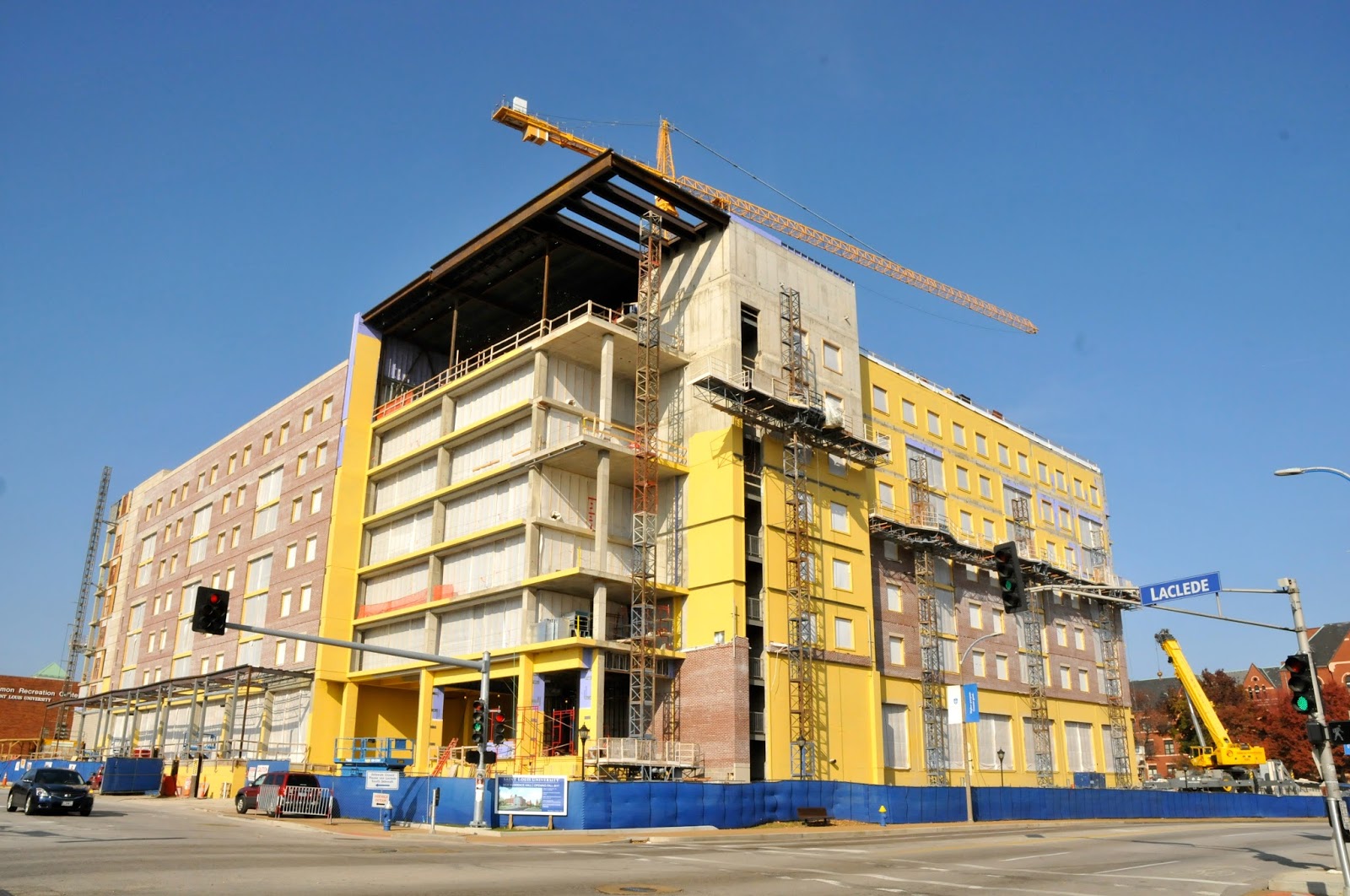
The second dorm, Grand Hall, is currently under construction at the northwest corner of Laclede and Grand.
The new residence hall approved by the Board on [September, 2015] will be a seven-story, 237,000-square-foot facility built on what is now a surface parking lot near Grand and Laclede. The new building will be connected to the adjacent Griesedieck Complex, the University's largest residential facility. 
Designed for first-and-second year students, the new facility will feature single and double suite-style rooms with a total of 528 beds. Plans also call for a 740-seat campus dining hall, as well as classrooms, study lounges and an outdoor plaza, among many other features. (source)
The cost of this building is estimated at $71M. This one was also designed by Hastings + Chivetta but built by University City, MO-based Alberici Constructors.

It used to be an uninviting, fenced-in grassy area and surface parking lot.

Before:


After:
Rendering image from slu.edu

progress as of publishing

The C-shaped building opens up with an indoor/outdoor dining area open to the north.
Rendering image from slu.edu

A nice setback, matching or slightly besting the adjacent Simon Recreation Center to the west:
Rendering image from slu.edu
These dorms are really changing the skyline profile of the main campus from all angles. It makes an impressive impact from Interstate 64 heading eastbound on the elevated lanes.

The height is equally impressive from Grand Boulevard at Chouteau:
Hopefully this good urban design will continue south at the Medical Campus in the Tiffany and Gate District neighborhoods and translate into real neighborhood assets.