Sunday, November 27, 2016

Lafayette School Converted to Lafayette Lofts in Soulard

The Soulard Neighborhood recently had an exciting new residential development hit the market with the renovation of the former Lafayette Elementary School at 815 Ann Avenue. 
This beautiful school building was built in 1907 by renowned architect William B. Ittner. The school sits on a 1.59 acre lot and boasts nearly 62K square foot of space. Lafayette Elementary School was named for Marie Jean Paul Lafayette a French aristocrat and military officer who fought in the American Revolutionary War. It was active as an elementary school from 1908 to 2004 when it served ~200 PK-5th grade students.

Due to declines in the number of students due to massive population declines in St. Louis, the St. Louis Public Schools (SLPS) decided to sell several schools over several rounds of closings. While the school would have made a perfect charter or private school, the SLPS chose to prohibit use by such entities to avoid competition. There are currently 27 schools available for sale throughout St. Louis.

Lafayette was sold for ~$800,000 to Advantes Development, a real estate firm that has done several amazing projects in St. Louis including a conversion of the former Hope Lutheran School to 22 market-rate apartments at 5320 Brannon Avenue in the Southampton Neighborhood, branded as The Mack Lofts. 
photo credit: Advantes Development

Advantes corporate offices are located in the Hill Neighborhood of St. Louis, making them a true city company!

Advantes reportedly invested ~$3.5M to convert Lafayette School to 36 market-rate apartments (source). The conversion is quite impressive from the outside as all the architectural details remain intact, including the ornate brickwork and familiar lion fountains.
Since historic tax credits were leveraged in this renovation, several interior details were also restored with new uses. Per the St. Louis Post-Dispatch:
The principal’s office at Lafayette is now the residents’ laundry but the school's marble and travertine entrance, broad staircases and maple-floored hallways are restored to meet historic tax credit requirements.
There is protected off-street parking including covered parking, a large landscape surrounding the building and all the other modern amenities one would expect. A two bedroom/one bath unit leases for ~$1275/month.
photo credit: Advantes Property Management

This location is great with easy access to Interstates, public transportation, Downtown and South City. Most of all, this is a very walkable location with the beautiful Pontiac Square Park just footsteps away and local markets and businesses aplenty.
It's great to see this historic building get an extended life and new use, bringing vibrancy, positivity and new residential options to a great St. Louis neighborhood. 

The next historic schools up for residential conversion include a ~$5.2M buildout of 38 residential units in the Sherman School at 3942 Flad Avenue in Shaw (built in 1895, designed by William B. Ittner). This project is also being done by Advantes who made the purchase at $700K. (source)

Sherman is tucked right in the interior of a dense, historic neighborhood.
Then, the Gratiot School at Hampton and Manchester in the Clayton/Tamm Neighborhood (built in 1873) is being converted by Garcia Properties (another city business, located on Kingshighway). The St. Louis Post-Dispatch reports:
Joining the closed-school-to-apartment trend is Garcia Development Corp., which (on December 29, 2015) put Gratiot School, at 1615 Hampton Avenue, under contract for $414,000. Jenifer Garcia, a company owner, said the plan was to redo the school as 22 market-rate apartments.
Gratiot has 27,474-square-foot on 2.86 acres of land right at Manchester and Hampton perfectly located between I-44 and I-64. It served as the SLPS Archives for several years before they closed it in 2013.

Good to see these historic structures finding investment and new life. Let's hope there is a market for the many closed school in North City.

Friday, November 25, 2016

The St. Louis Shotgun

You've heard of the American foursquare and the flounder that are quite prevalent throughout St. Louis. But sometimes when I'm tooling around the city I'll run across a long, narrow rectangular home, some of which are colloquially referred to as "shotguns".

Here's a classic example from New Orleans, Louisiana:

Photo credit: PorterBriggs.com, the Voice of the South

I like this term and wanted to share some thoughts on how it first came to me and what it means and how three particular songs creep into my head each time I come across a classic example of a shotgun house:

"I said shotgun, shoot 'em 'fore he run now..."
"Shotgun": Junior Walker

"And you may find yourself in a shotgun shack..."
"Once In A Lifetime": Talking Heads 

"Well you're crazy mama with your ball and chain and your sawn off shotgun blown out brains..."
"Crazy Mama": The Rolling Stones

These are the songs that flood my brain when I see the many shotgun homes in St. Louis. They are interspersed all over town, north to south from Walnut Park West to the Patch. Though you kind of have to train your eye toward them, as most of them are rather nondescript.

I first heard the term from my girlfriend (now wife) when she first moved to St. Louis from Fairview Heights, Illinois. She rented a "shotgun apartment" in South City. It was the first time I'd heard it, but I loved the way it sounded.  So American! A house like a gun! I thought she was so cool for renting "a shotgun apartment in South City". She was hipped to the term from the landlord that showed her the property.

It's just another small piece of the story on how we fell for St. Louis, a mystery around every corner.

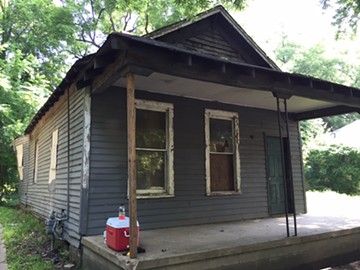
A shotgun is defined as a narrow rectangular domestic residence, usually no more than ~12 feet wide, with rooms arranged one behind the other and doors at each end of the house.
                        Photo credit: PorterBriggs.com, the Voice of the South


The thing that was curious about her apartment building is that it was a four family with two units at ground level and two units above. Therefore it was really more of a side-by-side shotgun, a double-barreled shotgun!

Actually, some might call it a "camelback" shotgun which is defined as a shotgun floor plan that includes a second floor at the rear of the house or directly atop the ground level floor (source). Probably not, but there are variations on the classic shotgun shack.

Either way, it was a shotgun floor plan, and in my many years traversing around St. Louis, I've come to love these homes even though most of the local examples do not have the ornate Victorian embellishments on the front porches like the ones in the deep South.

A recent trip to Memphis, Tennessee sealed my fondness for the style when I found out Aretha Franklin (among other blues/soul greats) was born in a shotgun shack...cementing my fascination and curiosity with these homes...entangling the home style with some of the most influential American music ever created.
Aretha Franklin's Memphis home through age 2: photo credit: Memphis Flyer

So it seemed like a worthy use of my Thanksgiving morning before the turkey goes in the over and the house is full of family to investigate where this term came from and give it some St. Louis context.

The earliest known use of "shotgun house" as a name for these dwellings appeared in a classified ad in the Atlanta Journal-Constitution on August 30, 1903. (source)

There are three main accounts on the story behind the term "shotgun":

The first is all about the floor plan where the rooms are all lined up in a row with no hallways, usually in the following order: living room, dining room, kitchen, bathroom and bedroom. It was an efficient use of space when cities were crowded and densely built and narrow and long lots were simply more affordable.

The second story is the most entertaining. It claims that if you opened the doors from front to back, you could shoot a shotgun clean through the house. This theory, likely more folklore than anything, was popularized by a prominent architect and preservationist in New Orleans, Louisiana named Samuel Wilson Jr.  He also suggested that shotgun-style houses originated in the Creole suburbs of New Orleans in the early 1800s.

Thirdly, it is a design element for hot weather environments, where if you open the front and back doors, a shotgun breeze will flow through all rooms of the house cooling it.

Most historians seem to agree with Samuel Wilson Jr. that the shotgun originated in the Southern U.S., mainly New Orleans with ties to West Africa and Haiti.

Shotgun architecture is now widely recognized as an African American contribution to American architectural styles.

Evidence suggests that this name is actually a corruption of the word “shogon.” In West Africa, “shogon” means “God’s House.”

John Michael Vlach, Professor of American Studies and Anthropology at The George Washington University in D.C. and director of the university's Folklife Program research backs up the origins of this architectural style came to New Orleans from West Africa via Haiti. 
In Haiti, enslaved Africans took the architectural form common to their homeland and using local materials built narrow buildings with gabled entrances, stucco walls, thatched roofs, and shuttered windows so they could enjoy the only privacy allowed to them. They also wrote African motifs into the exterior framing of their homes. 
When Africans in Haiti revolted in 1791, many European plantation owners fled to New Orleans, taking with them enslaved Africans still under their control. Many other free people of color migrated to New Orleans as well. This had a profound effect on the demographics of New Orleans. In 1810, the population of New Orleans was approximately 1/3 white, 1/3 enslaved Africans, and 1/3 free people of color, most of who had come from Haiti. 
In New Orleans, free people of color continued to build shotgun houses, replacing their African motifs with gingerbread trimmings. And the porch on the front of these houses was quite distinct from French homes whose outdoor areas were actually interior courtyards. The front porch on shotgun houses supported interconnectedness between people and gave neighbors a strong sense of community. 
John H. Lienhard, Professor Emeritus of Mechanical Engineering and History at the University of Houston decided they must be a regional invention from the Louisiana bayou country. That's where the older ones seemed to be concentrated. He traces the shotgun house to the early 1800s. Then he finds older shotgun houses in the sugar-growing plantation islands -- in Haiti and the Dominican Republic. Finally, he finds that same distinctive design in West Africa. (source)
The folklore of the shotgun being fired through the front door and exiting through the back has been somewhat debunked by at least one researcher. 
The explanation is a quaint one, and would likely have made sense for the Haitian homes upon which the American shotgun house design is based. Once the homes were erected in the U.S., however, doors were usually placed off center, so that a person conducting such an experiment would've probably taken a sizable chunk out of the rear wall of the front room. (Another etymological explanation is that the shotgun house takes its name from that aforementioned West African style of home. (source)
Another interesting note is that some historians claim the shotgun holds another American first:
The shotgun house brought a new home design concept to the United States: the porch. The overhanging roof along the front of the house created a stoop where a family could congregate on a hot evening. The front of a traditional shotgun house would usually encroach upon the sidewalk, and the house's porch gave rise to the longstanding New Orleans custom of visiting outside with neighbors in the evening (source).
As I was reading up this topic and Southern black culture, I couldn't help but think that our culture in St. Louis is exactly what is described in the South, or at least borrowed in some way. I currently live in a majority African American neighborhood and it became apparent pretty quickly that many black people in St. Louis are front porch sitters, this is where the visiting and socializing occurs. White people are more likely to take it to the back yard where fire pits, chairs, etc are set up. Many blacks that ended up in St. Louis came from the South looking for factory jobs, so maybe the many shotguns in the city and the front porch sits have New Orleans, or at least Southern roots. 

However, the shotgun is not exclusive to black families/culture, it eventually spread out of the South to all parts of the U.S.
The influence of the shotgun house would soon extend beyond the African-American community. By the beginning of the 20th century, shotgun house building kits were available on the market for $100. The structures soon began to appear in cities across the United States. Because of their simple design, shotgun houses could be erected quickly, which soon made them a common sight in the boom towns of the West.

But the very nature and design of these homes helped to strengthen the African-American community in the U.S. Because of their close proximity and porches, shotgun houses helped give rise to tight-knit neighborhoods. The shotgun house -- modest, constructed close to other homes, imported from the Caribbean and Africa -- has become somewhat emblematic of the African-American experience. Writes historian Denise Andrews: "The shotgun house represents the slaves' reaction to adversity, making sense of their new environment by modifying familiar living patterns. Cultural contact did not necessitate massive change in architecture; but rather an intelligent modification of culture" (source).
There are both wood-sided and brick shotguns all over St. Louis. I haven't found one with the ornate Victorian porch design, but I'm on the hunt.
Per the St. Louis Cultural Resources Office:
The shotgun house is often found in older St. Louis neighborhoods. Shotgun houses appear in frame with a front-facing gable, or in brick, with a hipped roof. Examples from this period can be found in Carondelet, Hyde Park and Old North St. Louis neighborhoods. 
The shotgun house at 8225 Vulcan, in Carondelet, is built of brick on a rubble stone foundation. Constructed about 1860, it is three rooms deep and has a low hipped roof, and simple corbelled cornice. From a low porch, the front door opens directly into the house's front room. The porch is a modern addition, but the remainder of the house is in close to original condition. (source)
But, shotguns are all over the city, not just the oldest parts. Look no further than Tower Grove South where my favorites are located right in a row on Morgan Ford Road just north of Stella Blues.
Here are some examples in the deep south of St. Louis near Carondelet and the Patch, including the one on Vulcan Street mentioned above on the city website.
 8225 Vulcan Street
But they are located all over, north to south. St. Louis has shotguns in spades. Enjoy them.

Tuesday, October 25, 2016

Defining Home And Where You're From

A topic I find fascinating is the definition of "home" and where you are "from". Thoughts on these words were spurred by an article I read recently in the Riverfront Times.

I take a lot of stock in these terms as they seem to predict character and experience; at a minimum, the way you define "home" and where you're "from" are good indicators of who you are.  A strong sense of place is something I respect, you just can't lie about these things.

I for one am proud to be from Illinois and call St. Louis...well wait a minute, not so fast. This requires some introspection...what is home?

At times St. Louis feels like home, but for the most part, I feel like Illinois better meets my personal definition...even after living in St. Louis longer than any other place.

But, back to the RFT article that got me once again thinking about this topic.  I couldn't shake the thoughts on the meaning of "home" after reading an article that touched on the topic through the lens of a couple of my favorite things: music and where you're from.

The article: "Pokey LaFarge Is Looking to a Future That May Not Include St. Louis" was written by Thomas Crone and published in the Riverfront Times on February 3, 2016.

If you don't already know, Pokey LaFarge is a well-known musician who deals in American blues/county/folk/jazz music; but, done in a way that is not overly derivative, it's fresh and original...and steeped in history and executed with soul and style and always reminds me of the Midwest.

A true talent.

Anyhow, the combination of the story's title paired with the caption under the first photo got me. It read: Pokey LaFarge: "It's not my home, it's never been my home. I'm from Illinois."  He was speaking about St. Louis and I couldn't help but think "me too". I'm from Illinois but have lived in St. Louis by choice in my adult years...I knew this was going to be a good read.
Photo credit: Joshua Black Williams


Immediately relating to this guy, I started thinking about my hometown in Illinois. It's one of those moments when you read something and get lost in thoughts and memories and contemplation. I couldn't wait to get back to the article. 

As I read through, several things stuck out. First, when discussing the potential of moving on from St. Louis, LaFarge said:
"I think it's something that people have gotten wind of, and the game of telephone is going on," he says. "Of course I've thought about moving from St. Louis. No offense to it, but there's no industry there. There are not as many musicians to play with there. And when you're at the point that I'm at, looking for a new challenge, certain parts of the music business don't exist in St. Louis. My whole team lives in different cities, like Nashville, New York and LA. The opportunity to write for film... I've thought about that for over a year. I'm not from St. Louis, but it's the only place that's felt like home. Being close to my family up in Illinois is great."
And then again, LaFarge discussed playing LouFest and the back and forth of praise/criticism felt in the small St. Louis music scene as a successful artist:
"It's the park that birthed our World's Fair, a historic place," he says. "It's a landmark in our city. So that's not lost on me: the fact that it's a national festival, run by C3, and has our name on it. There's a certain amount of representing you've got to do. Among these other national and international acts, you're there to try to represent St. Louis....I'm sorry, but I've lived there over eight years. I'm not from there — it's not my home, it's never been my home. I'm from Illinois. And as much as I've represented St. Louis, there's a certain amount of people that have made me feel what it is and what it isn't."
There's so much to those statements, even a slight contradiction, if I'm interpreting it correctly. There is what feels like home and the factual home. Regardless LaFarge has lived here and represents the pluses very well...usually the people that I've run into that do this best aren't necessarily from St. Louis.

LaFarge's take was just so honest and refreshing to read, it stopped me in my tracks and got me thinking once again about the definition of home and growing up in Illinois and living in St. Louis and what that means to me. It also got me thinking about how people who live in cities west of St. Louis identify with St. Louis as their home even though they don't live here. I'm going to have to publish more on that topic as I find it one of the most fascinating and frustrating topics in this region. For whatever reason this sticks in my craw and as I get older, I don't want things in my craw. I want a clean craw, grudges only breed negativity.

I like when people are transparent and real when it comes to the city they live in and where they are from and what they consider home. This is how I try to represent myself on this blog.

But back to the definition of home...

I have lived in St. Louis for 22 years. I've lived in six different neighborhoods, three different houses and four different apartments/flats. I'm fascinated with St. Louis and it is my home of choice; it's my adopted hometown. But I'm not from here.

My personal love of St. Louis is well documented on this blog. Even though I am critical at times, I love it more than any U.S. rust belt city and I want the best for it and try hard to help St. Louis become a better place in my small/limited capacity as a citizen. 

That said, I'll be curious to see if St. Louis feels more like home as time marches on. But if I'm being honest as of today, it doesn't. And that is not a diss, it's just a simple fact that I and others in my family who ended up in St. Louis agree with. I'm from Illinois. I live here. My kids are the real St. Louisan's; but I'm a transplant.

I grew up and went to elementary and high school in a city just east of St. Louis called Belleville, Illinois. It is a proud city of ~42,000 and has a rich history and identity all it's own, distinctly separate from St. Louis' by many measures. Although the home I spent most of my formative years in is only 9.7 miles from St. Louis, it is a world apart. To give Missourian's a taste, it would be about equidistant from St. Louis as Town and Country or Florissant, MO. You'll have to just trust me on the differences. St. Louis was simply not part of my world until I moved here...it was a place I occasionally visited and that's it.

But, I gave up all my Belleville privileges long ago. I can't influence or leverage what they do, I'm an outsider from a citizen perspective. I want nothing but the best for Belleville, but only a charlatan would claim I have a stake in that city.

I made the leap across the river and don't regret it for a moment. But one point I'd like to make about this region is...you can't lump these places and these communities together. Belleville is distinctly different from St. Louis, so are Town and Country, Florissant, Ferguson, University City, you name it. I know the distinctions very well when comparing Belleville to St. Louis. I don't, however know the distinctions between the city and the many cities in the suburbs. I'm working hard on trying to understand it by repeat viewings of "Spanish Lake", reading "Mapping Decline" and trying to be a kinder, more open minded listener when County people claim St. Louis as their home, but can be pretty harsh on St. Louis at arm's length from the comfy confines of the burbs.

I can only claim that I'm from Belleville and I live in St. Louis, the definition of home is less factual...but, southern Illinois will always feel like home, way more than the city I've lived in for 22 years. I can't shake the formative years in defining who I am.

Like Pokey LaFarge, I'm not from here. I love it here, and I think he does too and has represented St. Louis very well both here and abroad. But, I can see why you'd want to move. But for me, that move will not be to a small town in the suburbs where you still claim the positives and separate yourself from the negatives of St. Louis...it'll be to an entirely different place.

Own where you are. Love the one you're with.

To most in this region living in St. Louis is subjective. To me, it is not truthful and does not align with facts and reality. The separation damages us as a region and the lack of honesty makes talking about the needs of St. Louis and the 90 or so cities in St. Louis County very tough.

Owning and engaging in your city...claiming it...is the first step to being proud of it and understanding how to make it and the region the best place.

Calling out these geographical, political and real distinctions can quickly be dismissed by detractors who want the best of both worlds (suburban living/STL identity) as provincial or parochial. I say until we are one big happy taxing and voting block...you know...one city, we should be proud of where we live, and proud of where we're from. But most of all, honest and transparent.

I am a small town, suburban, Illinois person at the core. I have learned some urban behaviors, and frankly I'm way more interested in St. Louis than small towns and suburbs these days, but it is good to recognize both.

But bloggers, journalists, politicians, residents...everyone should all say where they're from...own it. And then work for change and unity.

It is not divisive to accurately state where you're from and demand honesty in conversations. It is this level of discourse that is required to establish a baseline understanding of this region so we can move it forward. At some point in time, the many suburban cities in the county as well as the 300,000 or so St. Louisans are going to have the opportunity to vote to merge the region like our Midwestern peer cities of Kansas City, Indianapolis and Louisville.

How can we make that important decision if we are not honest about the realities of the region.

Sunday, October 23, 2016

A Discussion On Tax Incentives

I recently did a blog on all the development activity on De Tonty Street in the Shaw Neighborhood. In that post I made the following comment:
"It's really good to see this level of investment, taking vacant lots and bringing dignified homes and much needed tax dollars back to the people of the city....remember, a large part of the school budgets come from property taxes."
While this is true, it was pointed out to me in a brief Twitter exchange that while there is a little money added to the city coffers in the case of the De Tonty Street town home and apartments, there are significant tax abatements in place for the developers that allow them to pay very little property taxes for many years:

Now, my modus operandi as a St. Louis blogger is not to mimic real journalism where everything I say is fact checked, verified and sourced.

The writing I do here is strictly done as a hobby/no pay and that's what keeps it fun. I try to focus on my optimism and not my cynicism for St. Louis. I try to give a personal perspective on city topics through a typically cup-half-full lens.

That said, I want to gain an understanding of how tax abatements work and what they impact. I want to understand why so many people seem to be upset by this process (except for the developers of course). I've noticed this trend on social media and in some mainstream media outlets.

Basically, I want to know enough to be a critical thinker on the matter...and today, I stand ignorant on the subject.

And if someone takes the time to reply with thoughtful exchanges of ideas or data on social media, I'm open to continuing that conversation. So I reached out to Andrew Arkills through Twitter and a couple days later, we're talking over coffee on the subject.

The purpose of this post is to provide some resources for those who want to learn a little more on this complicated topic and to share some of the things I learned from Andrew and some of the opinions we shared.

So why does Andrew care so much and seem so knowledgeable on tax abatements?

He works in the private sector in the supply chain field where he's tasked with budget and cost of goods savings for his employer. He's a numbers guy and is fiscally conservative by training. Best of all, he's a concerned citizen of St. Louis and is worried about what he considers abuse of tax abatements, the process of how they are awarded to developers and the overall city budget.

Why should we be concerned with tax abatements for developers?

We are told that the city's budget is barely balanced and the the schools don't have enough money and that the city's credit rating has been downgraded.

Tax abatements don't fit the model of paying down debt, providing services and maintaining our infrastructure. 

When you listen to why most people move to the suburbs, they will often cite crime and/or schools as critical factors. Schools receive a significant portion of their budget from property taxes. 

A breakdown of what your property taxes fund can be found on the city's website and below:


~58% of property taxes go to the schools, but the zoo, museums, libraries, junior college, parks and recreation and routine city maintenance and services are funded this way as well. This is important stuff toward making a city livable. 


For instance, the zoo has mentioned the possible need to start charging for admissions due to losses in tax base that are due in part to abatements.

It affects us all.

But there is headway being made toward making some much needed changes to the system.  A study was commissioned by the St. Louis Development Corporation (SLDC) and completed in May, 2016. It takes a comprehensive look at tax incentives. Here's an excerpt from the executive summary:
As with most major US cities, the City of St. Louis uses a variety of tax and other incentives to foster economic development. These incentives include tax increment financing (TIF), tax abatements and bond financing; they are often coupled with state and federal incentives, such as the state historic tax credit and the federal New Markets Tax Credit. Over a 15 year period, the value of the primary City tax incentives (through TIF and tax abatement) has totaled $709 million. 
While economic development incentives are broadly used, there are legitimate questions about their efficacy and administration. To gain a better understanding of past and present use of incentives in the City and across the country, the St. Louis Development Corporation (SLDC) commissioned this study.
The report is nearly 200 pages and is quite thorough, the St. Louis Post-Dispatch and NextSTL both wrote very insightful pieces on the report. But, I would start with the full report if you want to know the extent that incentives have been given throughout the city.

Click HERE to download the full report.

I asked Andrew where he got the information included in his tweet on how much taxes the specific De Tonty town homes and apartments project received and he said you can find tax information on a parcel by parcel basis on the city's Geo St. Louis website. This is where you can enter an address and see what property taxes were paid as well as the assessed value. For instance, if the developer paid taxes for a year when they owned a lot and paid a small amount of taxes, this is what the value stays at for X number of years after the project is completed. Those terms are negotiated between the developer and the city.

Sometimes this tax information is hard to find. Andrew found that when a property is about to be abated, the history is removed from Geo St. Louis so you can't see the amount the city lost. By his best estimation, the city is not even tracking how much they are removing from the tax base. There is no easy way to track the incentives, and from an audit standpoint, this can be risky and untraceable. 

The city is not sharing the annual amount it is giving away. It is not being tracked. Andrew has tracked it for a year. The SLDC study claimed the number is around $709M over a 15 year period.

We both agreed that we are not anti-development, and there are cases to be made where TIFs and abatements are successful: think of cash cows like IKEA that will likely pay off the municipal bonds earlier than the the agreed upon term, or historic tax credits that help incentivize preservation of our built environment. These make sense. 

But if we're going to move forward we have to do so in a smart, coherent manner. As of now, incentives are managed on a ward by ward basis.

In some wards, a community development corporation (CDC) may be calling the shots; as is the case in the Central West End; but where neighborhoods do not have that resource, it is largely up to the elected alderman to assign these incentives, seemingly on a whim.

Andrew explained that by statute, abatements have to be sponsored by the alderman. A developer can approach the SLDC or the alderman. A bill then gets introduced in the alderman's name, and they have to specifically say "no" if they do not agree with the incentive. Otherwise, it gets introduced to the floor and once it gets to the point, it is hard for it not to pass.

We discussed the lack of process, formula or rubric to fairly qualify and consider incentives and appropriately assign them across the city on a project by project basis. We need a scoring matrix that proves the benefit to the citizens as well as the developer.

It would be much more transparent and palatable to the citizenry if a formula was in place to remove the subjectivity and relationship aspect. That formula could include important variables like a certain percentage of affordable housing units, minority participation in construction, numbers of jobs it will create to offset the property tax loss, etc. 

But it is hard to stomach incentives for a business to pull a musical chairs and move from one part of the city to another, not creating new jobs or services and abandoning another property in another part of town.

We agreed that you don't want to close the door entirely on incentives; clearly there are cases where it is needed, like struggling neighborhoods where there has been no development for years and the infrastructure has rotted or is non-existent.


A compromise seems easy in theory, we just need the political will to make it happen. The great thing is, we both agreed that more people are paying attention to the system. We should demand a coherent, streamlined, process-based system. We simply need oversight to help fight cronyism.


We are not alone in this thought, the St. Louis Post-Dispatch wrote an excellent editorial piece making a strong case for a plan:
The plan should also encourage ending a quaint political perk known as “aldermanic courtesy,” which means an alderman doesn’t ask too many questions of a colleague requesting a tax abatement in his ward. 
There should be healthy debate and lots of scrutiny about the best way to encourage balanced development. If well-connected homeowners or developers are buying property in healthy or upcoming neighborhoods yet still receiving tax abatements for five or 10 years, aldermen need to be asking why.
The formula has to be transparent and used justly and fairly across the city. People will be okay with that. We need an economic development plan to share the rules and look at the city's needs and what needs to be developed, what corridors are being prioritized for development. That would make it easy to see the marching orders and see the goal. Like if the city had a goal to get rid of 25% of their LRA properties by x year, we'd watch it change.  Say for instance if Page Avenue was prioritized as a commercial corridor, we could agree to incentives to bring back some much need services to an underserved population.  Incremental change is accepted if it is transparent and rules are followed.


Hopefully as the mayoral debates come to fruition and the aldermanic numbers decrease, this will be part of the discussion. We share the hope that while social justice, race, crime and poverty are huge issues and are the ones that lend themselves to headlines and attention grabbing quotes, we need to keep the tax base system as part of the discussion.


Hopefully people like Andrew will be the ones to keep the discussion going and convince more people like me to take a harder look, do some reading and try to think critically on this important issue.


Hey, nobody wants to pay taxes, my home has historic tax credits that limited the amount of taxes I pay. That will expire soon and my taxes will go up. I'm not happy about that, but I accept it. 


I'm just not convinced each and every project needs TIF or abatements. We need a smart, transparent, just formula. It's hard to believe a ten year tax abatement is necessary in CWE, Shaw or Tower Grove South. The developer needs to fund projects, not the city. The schools need the money. We can't keep giving away the treasury.


I think we'd be a much better city.


I'm hopeful that we can make these much needed changes and we can elect people with the will to execute a plan.

Saturday, October 22, 2016

Employee Time

I went into Randall's on a weekday to buy some beer. It was outside of my normal routine, during the day-ish, maybe 3:00 or so. The vibe was different. The employees were running the show...by show, I mean the music in the place.

The tunes were decidedly not what I usually hear in this place on a Friday or Saturday night. They were employee-selected. The volume was meant to be heard. It sounded great to me, the place was empty of customers, but rocking.

Everyone was singing in somewhat unison...it was together. Enough to be noticeable.

Let the neighborhood be the neighborhood. Let the employees listen to what they want. Let them call the shots and you suddenly have a neighborhood place in the true sense of the word.

Happy people.

Never have I learned more about the word community than I have working as a lawn mower, glass cutter, delivery driver, fast food hack, newspaper telephone salesman, bus boy, dishwasher.  When you work these jobs, you realize how simple community can be.

Our strength in St. Louis is our people living real lives, working real lives...living right here.

Let the soundtrack reflect that and we'll all be happier and realer...a place that isn't canned and presented to consumers.

The little things make me happy living here.